Cuba: Day 5
The 6th entry in a series on my trip to Cuba in December 2024 with the Witness for Peace Solidarity Collective.

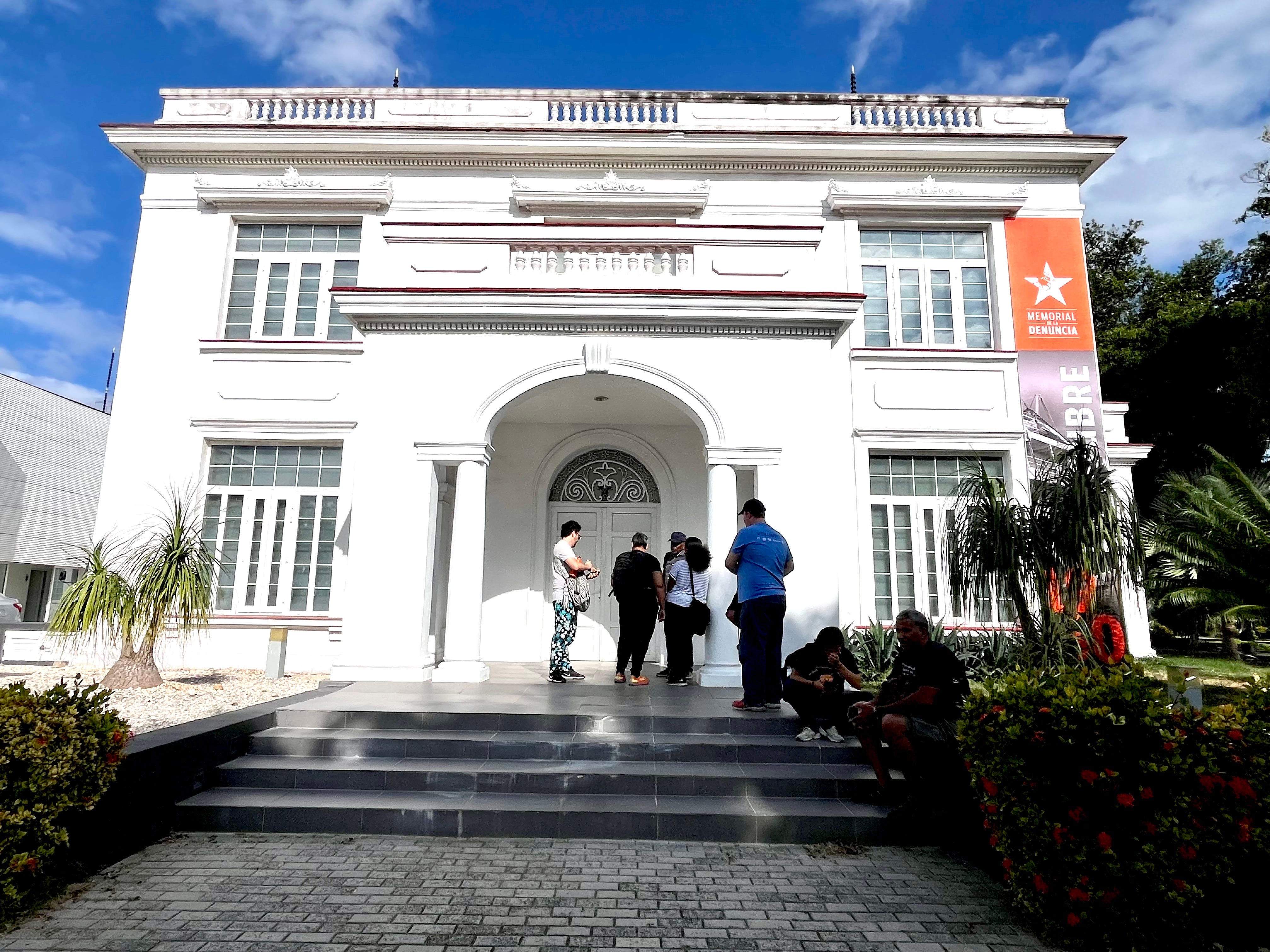
That morning in the “classroom” we met with Guillermo Rodríguez, a lawyer and mediator in the International Arbitrage Court for the Cuban Chamber of Commerce. He was on the team that drafted the new Family Code of the Cuban Constitution, which is what he was there to talk about.
Even before the Revolution, Cuba was socially progressive. This is partly because the Roman Catholic church wasn’t as strong in Cuba due to the mixing of Spanish, African and indigenous cultures. Divorce was legalized in 1917, one of the first countries to do so. (Even now, there are countries in Latin America that haven’t legalized divorce.) Cuba was an early adopter of female suffrage too. It was the 34th country to legalize same-sex marriage in 2022. Same-sex couples can also adopt.
After the Revolution, public policies changed radically, and there was a need to change the laws to reflect and reinforce those policies. Too much faith was put in the ability of policy to change behavior. There also wasn’t enough regulation to go with the policies.
The first Family Code was passed in 1975, but it no longer matches the current reality of Cuban society. It also needed to be updated to conform with new UN conventions and charters on the rights of women, children and the disabled. The convention on women’s rights was passed in 1979. The Charter of Children’s Rights was passed in 1989. (The US was the only country not to sign it, saying it didn’t want to limit parents’ rights.) In 2006, the UN passed a Charter of Disabled People’s Rights.
The UN convention set the minimum age of marriage at 18. Under the old Cuban law, 14-year-old females and 16-year-old males could get married with their parents’ permission. At the time, 95% of married 14-year-old girls were with foreigners. They may’ve been trafficked. Trafficking carries a prison sentence of 20+ years in Cuba, but it’s rare.
Rodríguez said all family laws in the world are linked to the idiosyncrasies of local families and communities. Everyone has their own ideas of how families should operate. For the new Family Code, they needed to find “norms that more or less could cover the interests of everyone.” Each draft of the Code was subjected to public comment and voted on. There were 5 consultations with the people before the final draft.
The changes in the Code are meant to:
protect family members from domestic violence,
provide equality within the family and
make sure the children’s interests come first.
The mother and father have equal rights and responsibilities. In the old code, mothers had more rights. Grandparents also have rights to grandchildren. Adoption is now allowed until the child is 18; it used to be 16. Adoption between relatives is permitted under the new code. Step-parents have rights equal to biological parents’. Surrogacy was legalized, specifically to raise the birthrate. But there’s no compensation for surrogates; it’s considered “solidarian gestation.”
The scope of alimony was expanded. A mother can request compensation from the father even before their child’s birth. The compensation can be returned if the paternity is disproved. If a parent dies or separates and they can’t support their children, it’s required by law that the parent’s siblings will provide for the children. If the parent has no next-of-kin, the state provides. If a woman is pregnant and her partner or the father abandons her, she can demand a pension. But these examples only apply to women in dire straits.
To address a common situation, the following policy regarding caregivers for the elderly was included in the new code. The caregiver can inherit the elder’s house (if they’re put in the will). If the caregiver gets ownership of the house while the elder is still alive, they may not rent or sell the house. But some caregivers abuse this situation, quit taking care of the elder and even kick the elder out of the house. In that scenario, the property reverts to the elder, even if no contract was signed.
Cuba’s population is in decline and aging. There are 3 domestic factors: first, the birthrate, which has been low since the 1980’s. The second factor is life expectancy, which hovers around 78-80. The third is emigration, an option mostly exercised by young people.
For every 4 households in Cuba, there’s 1 person under 14 and double that many elderly. In the last 5 years, they’ve had more deaths than births. This is partly due to a highly educated population, especially among women. Teenage pregnancy has decreased to 8% of all pregnancies. It used to be much higher. The drop can be attributed in part to the legality of abortion and educational campaigns.
Rodríguez said that, when he was in school in the 80’s, there were opportunities to study in the Soviet bloc for free, but people didn’t go because the Cuban economy was good. Over the last 2 years though, about 300,000 Cubans immigrated to the US. He said Cubans admire the US’s creativity and development. Before the Revolution, some US technologies were released first in Cuba, especially cars.
He guessed that about 10% of Cubans live abroad. Cubans’ freedom of movement is limited only if they are in the midst of legal proceedings or are suspected of having state secrets.
Cuba was late in combating domestic violence. Other countries in Latin America have more complex systems for addressing the problem. Cuba has instituted civil and criminal penalties. Those found guilty of domestic violence can lose inheritances and property and face fines and restitution. A woman whose partner prevents her from working may be compensated for the time she was not allowed to work. Even if a complaint of domestic violence is withdrawn, the judge can still move the case forward. If the situation is unsafe for the victim, the accused may be taken into custody.
“All institutions are part of prevention,” Rodríguez said. Clinics have prevention departments to deal with domestic violence. There are Prevention Commissions in rural areas, as well as the Federation of Cuban Women. The Family Code also created ombudsmen in the legal system to provide support for women, elderly and youth.
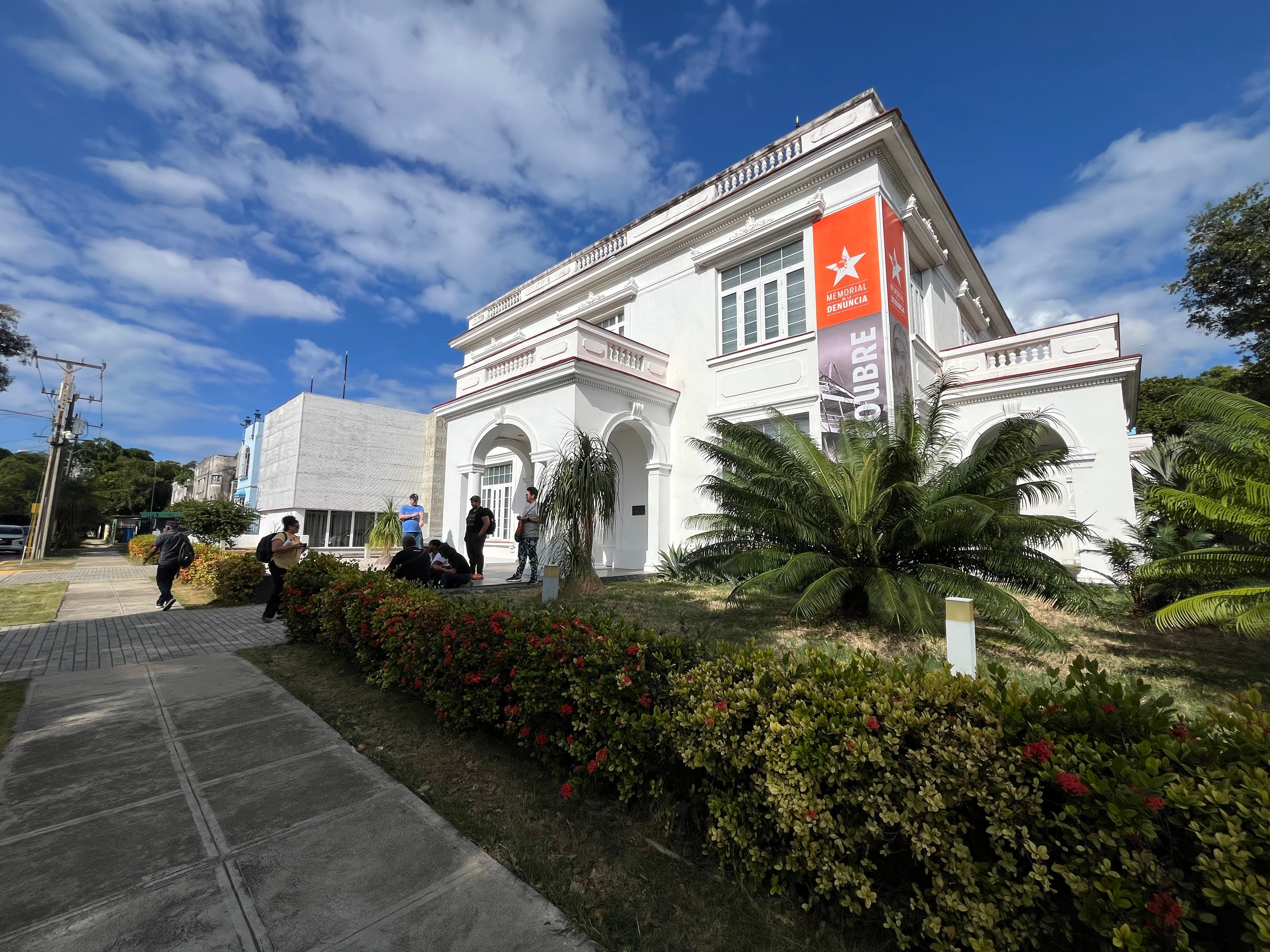
After the Family Code discussion, we visited the Memorial de la Denuncia (“Memorial of the Complaint”), a museum documenting the US’s war against Cuba since the Revolution. It’s housed in the former Ministry of the Interior.
Our museum guide discussed the CIA-orchestrated coups in Iran (1953), Guatemala (1954) and what is now the Democratic Republic of Congo (1961), which all took place during Alan Dulles’s time as Director of Central Intelligence. The CIA has waged biological warfare against Cuba, introducing dengue fever, other viruses and more than 14 insect and animal pests. Now they use social media to broadcast propaganda.
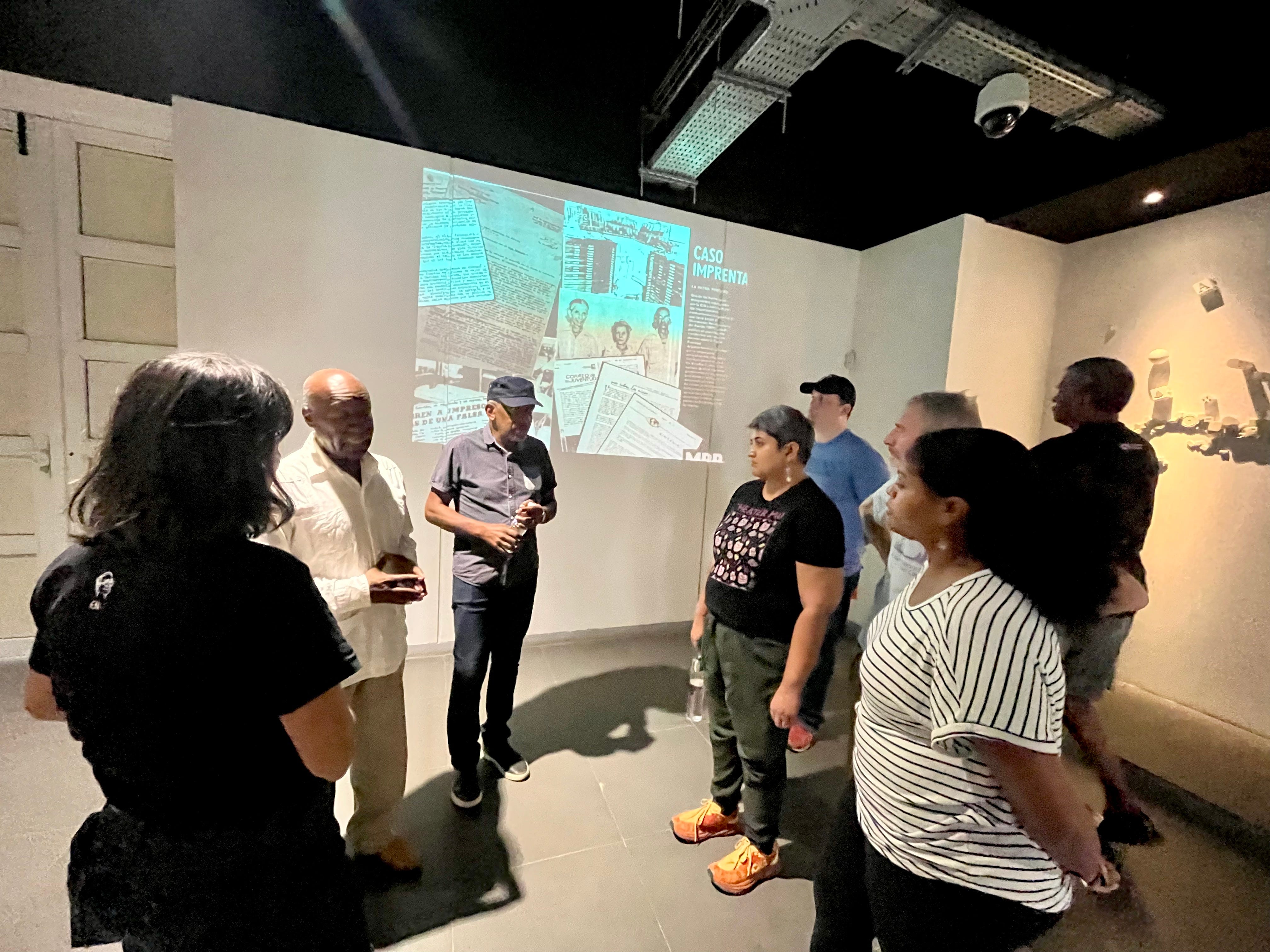
“They said, ‘We’re going to give internet access to Cuba.’ But they just wanted that in order to bombard us with their subversive messages,” the guide said. Text messages were sent to Cubans telling them to set fire to dumpsters, break park benches, short-circuit power lines and damage ATM’s. He warned about the US’s hegemonic media influence on the world.
The first post-Revolution invasion of Cuba was organized by Rafael Trujillo, the Dominican dictator, in August 1959, abetted by the Organization of American States (OAS). The force, known as “Alpha 66”, took speed boats to different coastal towns. They attacked ships and kidnapped fishermen.
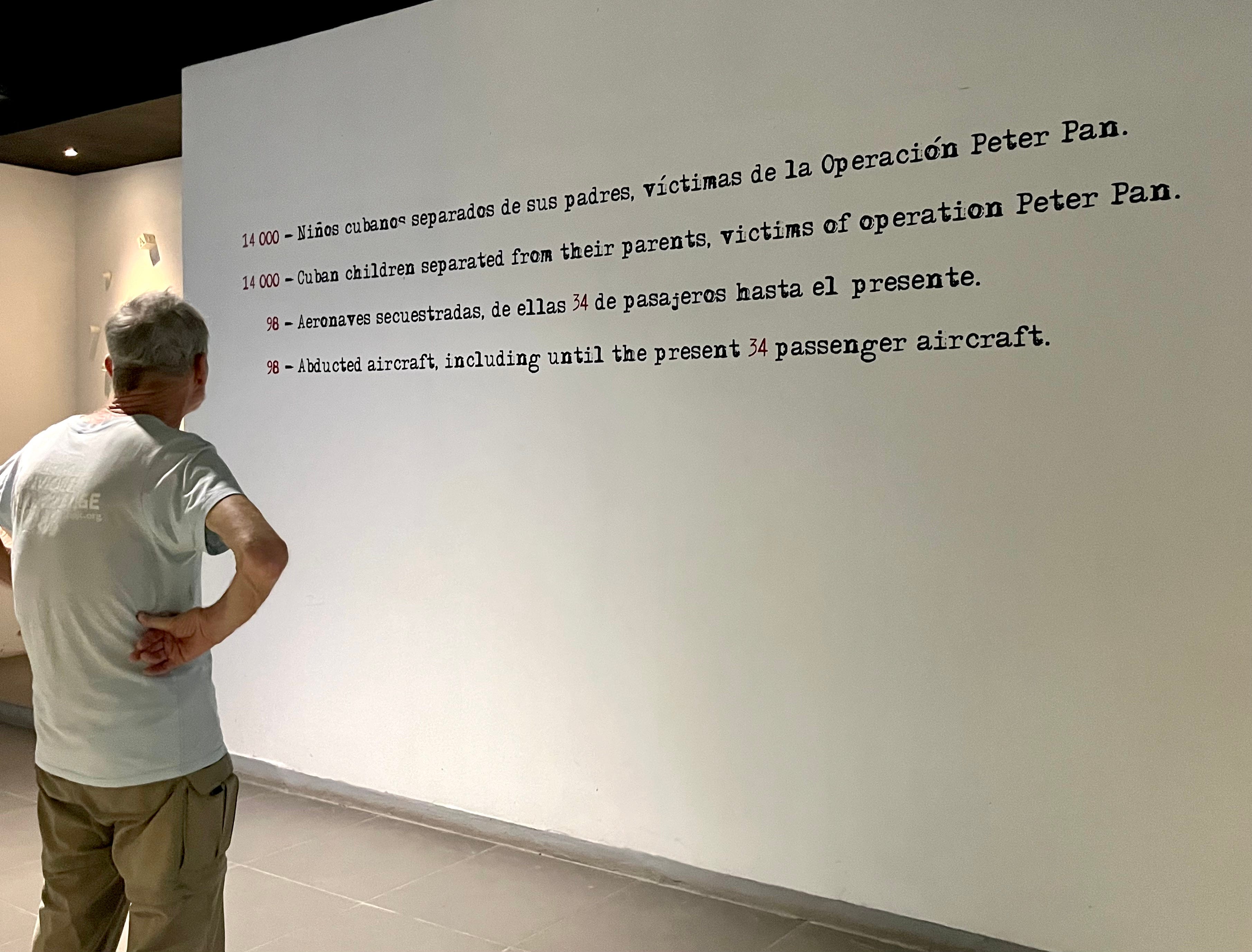
The leader of the operation, Eloy Gutiérrez Menoyo, was captured and spent 22 years in prison. The president of Spain then requested amnesty for him. Fidel assented and sent him to Spain. From there he went to Miami and founded a group called Cambio Cubano (“Cuban Change”). In 1997-8 he went to Cuba and advocated for multi-party US-style democracy. He moved back to Cuba in 2003 and died in 2012. The guide pointed to this as an example of Cuban tolerance of dissidents.
During his time as Secretary of State, Henry Kissinger spearheaded anti-Cuba operations. In 1976, two Cuban diplomats in Argentina were kidnapped and killed. Their remains were discovered 36 years later. Declassified documents have since revealed US involvement in these events, as well as more than 737 attempts on the life of Fidel Castro. In 1997 the CIA started planting bombs in hotels to scare off tourists. One went off in a hotel lobby, killing an Italian tourist. Luis Posada Carriles, who killed 73 people in 1976 by bombing a Cuban airliner, admitted to the hotel bombing, but the Italian president said nothing.
Our guide called Guantánamo Bay an illegal base. It was given to the US to be a naval base. It’s a prison, everything but a naval base. The US pays $4,000/year to Cuba (via the Swiss embassy in Havana) in rent for the land, but the Cuban government has refused to accept the payments since 1959.
According to the guide, Cubans make no distinction between Democrats and Republicans. Of all the US presidents who have overseen the embargo, he said that 11 were Protestants, 2 were Catholics, but “all of them are violating the Scriptures.” Obama is still the only one to make an official visit to Cuba. During his visit, he called for a “clean slate,” to forget what had happened before.
In the afternoon we returned to the “classroom”. This time we spoke with Jordi, an economist. She discussed the stages of post-revolutionary Cuban economic development.
The first stage started with the Revolution in 1959. It involved shifting away from US technology towards Soviet. Cuba joined the Council of Economic Support with the USSR in the 1970’s. The 2nd stage was opening its economy to the rest of the world after the fall of the Soviet Union. This stage began with the “Special Period”, when Cuba was short on food and fuel and had regular blackouts. (The end of Soviet oil imports cut Cuba’s oil supply in half.)
During the Special Period, professionals went to the country and bartered with farmers for food. The Gross Domestic Product dropped by 35%. Cubans started charging tourists more, the so-called “tourist price”. There was also a reorganization of the government. New departments were created while others merged. The government allowed private businesses to open. This has caused wealth inequality to grow.
Now there are 11,000 micro- , small- and medium-scale private enterprises, but they still comprise a minority of the economy and exports. The government controls most of the mining, petroleum and tourism industries. Private companies don’t operate in the most important fields, like telecommunications, the military or medicine. The public sector also includes “sacred” enterprises like schools and hospitals in order to maintain social equality.
The 3rd stage of Cuban economic development is the current crisis that began around the time of the COVID-19 pandemic. Inflation has accelerated, driven by internal and external factors, such as the pandemic slowing trade. In 2019, freight rates for Cuba increased due to the US prohibiting ships from docking at a US port for 6 months after docking in Cuba. The government paid 2 billion pesos to furloughed workers and 300 million pesos to fight COVID. Food scarcity raised prices as well. In 2022, inflation in Cuba hit 70%. The post-pandemic rise in prices has become permanent.
The pandemic also reduced tourism. Before COVID, they got about 4 million tourists a year. In 2024 it was 2 million or less. There’s also medical tourism in Cuba. Under Obama, US cruise ships visited and 7 airlines were licensed to travel to Cuba. Trump cut that back, along with everything else.
During the pandemic, no other country shared vaccines with Cuba. But Cuba had more than enough vaccines for its own people, thanks to the Department of Biotechnology started in the 1980’s. Cuba developed 5 different COVID-19 vaccines.
Jordi described Cuban medicine as preventive and a “medicine for human beings.” She has seen the impact of Cuban doctors in other countries. She has heard from patients how Cuban doctors treat them differently than their own doctors. The Cuban medical model has been adopted by other countries, as far as prevention and community embedding.
An energy crisis has resulted from a lack of spare parts to maintain power plants. This is caused by the US blockade. An oil tank fire in 2022 greatly reduced Cuba’s oil supply, but Mexico and Venezuela helped to replenish it. There have been damaging hurricanes in recent years. Blackouts have become commonplace. Jordi recommended a transition to renewable energy to mitigate these vulnerabilities.
Cuba recently became an associate member of BRICS, an intergovernmental organization made up of Brazil, Russia, India, China, South Africa, Egypt, Ethiopia, Indonesia, Iran and the UAE. Cuba is opening up to direct foreign investment and collaboration. They’re also trying to widen the scope of investment.
It used to be that foreign investors could only own half of a business in Cuba. The Cuban government owned the other half. Now there are two or three 100% foreign-owned businesses, probably hotels, but the government still gets half the profit.
The Foreign Trade Ministry has a website advertising business opportunities to appeal to investors. A “Zone of Development” was established in the port city of Mariel, whose harbor was dredged to invite trade with ships passing through the Panama Canal. But, despite years of this campaign, they haven’t attracted enough investment.
Cuba has 2 currencies: the CUP (Cuban peso) and CUC (Cuban convertible peso). The CUC was required for the domestic market. Both were pegged to the US dollar. In 2021 they tried to combine the currencies, but prices rose, especially for energy. Big exchange houses opened to acquire foreign hard currency. Now Cubans use multiple foreign currencies (US dollars, Canadian dollars, euros, Mexican pesos, etc.), and the Cuban currencies have lost value.
Cuba’s main economic problems are food, energy and finance, and these all stem from the #1 issue: the US blockade. The total historical cost of the blockade is estimated at $144 trillion. The website CubaDebate.cu shows its effects. Cuba must constantly change trade partners and sources to evade US sanctions.
Trump was the first US president to enact Article 3 of the Helms-Burton Act of 1996. It allows Cuban-Americans to claim business losses for property seized by the Cuban government. Trials have begun in Miami to stake those claims. Cuba responded with the Law of Sovereignty and Dignity, allowing Cubans to register their property and assets to be shielded from US legal claims.
Since the Special Period, organic agriculture and gardening have waxed and waned depending on economic conditions: expanding in the hard times, shrinking in the good times when there’s money for expensive fertilizers. Another alternative to conventional agriculture is the Nerea family of fertilizers, developed by the University of Havana and based on Cuban zeolite, which can regenerate the soil.
Jordi stressed the need for a circular economy that produces no waste, guided by the mantra “reduce, reuse, recycle.” Urban and suburban gardens were grown during the Special Period. Jordi thinks they need to return.
It would be good to pay a visit to the Fundacion Antonio Nunez Jimenez de la Naturaleza y el Hombre in Miramar, Playa, between 66 and 70 at 5ta.B. www.fanj.org. They were catalysts in introducing permaculture during the Special Period and still provide resources to many urban farmers and gardeners. Contact Carmen Cabrera Lopez there and try to get an appointment with Liliana Nunez, the president.