Cuba: Day 4
The fifth entry in a series on my trip to Cuba 1 year ago with the Witness for Peace Solidarity Collective.

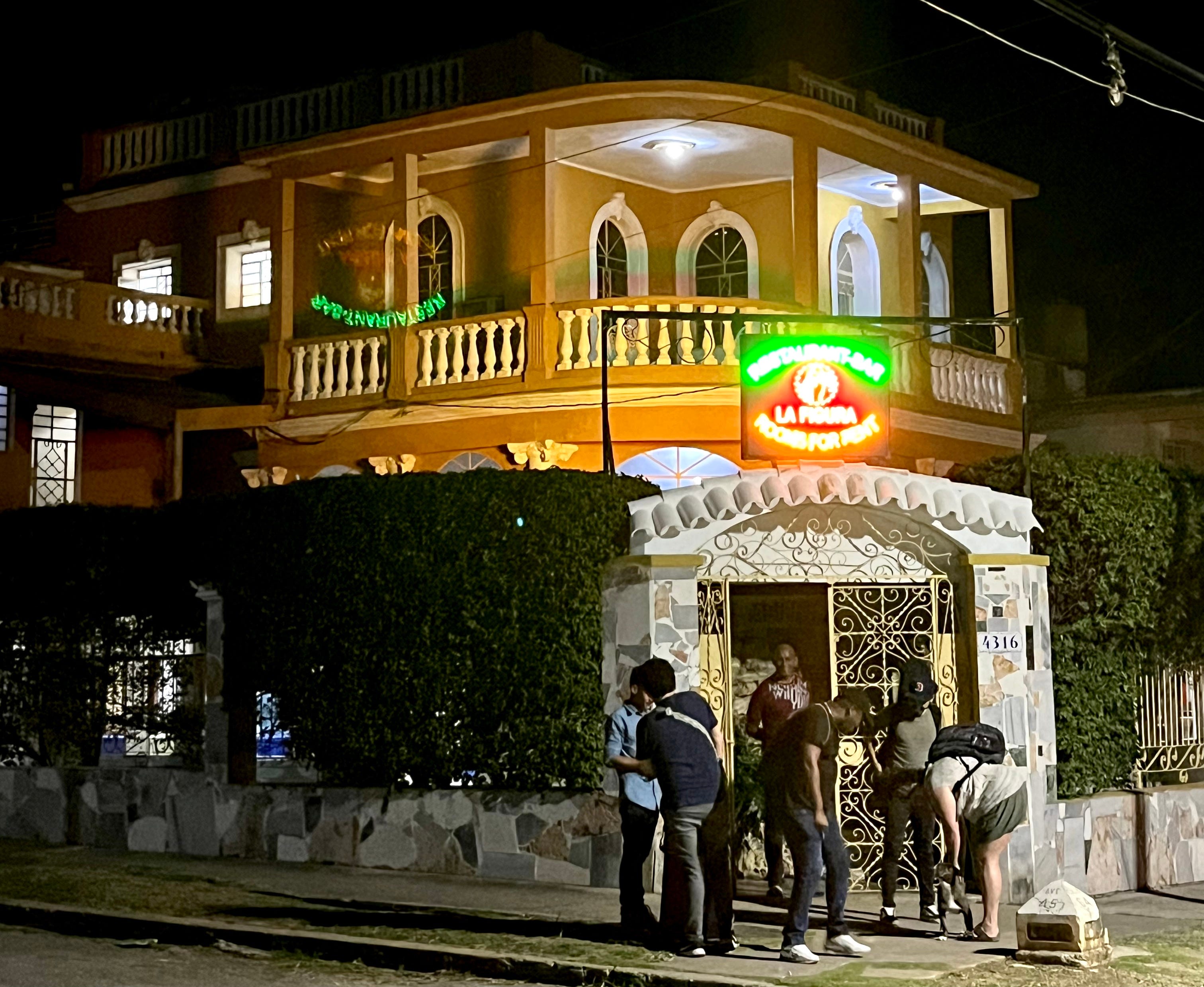
In the morning we spoke with Ángel Piedra, a media producer, about Cuba’s support for Angolan independence. The discussion began with a viewing of the documentary he made as his art school thesis. It was about the many letters Cuban soldiers sent home while serving in Angola. Piedra served in the military mission in Angola in 1988. He was there for a year.
The men sent to take his place in Angola got bombed their first night there and asked to go back to Cuba the next day. They’d been told the fighting was over. In accordance with the mission’s voluntary status, they were sent back home. Piedra’s group stayed until the next group arrived. They were all volunteers, and Piedra only went to a military school afterward.
While Angola was still under Portuguese control in the 1970’s, 3 independence movements emerged: MPLA (“People's Movement for the Liberation of Angola”), led by Agostinho Neto, UNITA (“National Union for the Total Independence of Angola”) and FABLA (“Force for the Total Liberation of Angola”), led by Holden Roberto.
By 1975, Portugal was on the verge of defeat in Angola. Portugal and the US were in talks with people from Somalia to invade Angola from the north. The Angolans requested Cuban advisors. The Cuban mission ended up lasting 15 years. The Cubans fought alongside the Angolans. They could understand each other due to the similarity between Spanish and Portuguese.
After MPLA triumphed, UNITA waged a guerrilla campaign against them, mostly in the south, with support from South Africa. In 1986, South Africa openly invaded Angola. South Africa had nuclear weapons, but the Cubans had air superiority. Most of the Cuban military was deployed to Angola, leaving Cuba vulnerable to invasion, as Fidel later admitted.
(Author’s note: This is wild to me. US intel must’ve known about Cuba’s vulnerability at the time. But, even if the US had wanted to invade Cuba, this came on the heels of their defeat in Vietnam. Domestic US popular opinion would’ve strongly opposed an invasion of Cuba, and the military may’ve been too demoralized. I think it also speaks to the popularity of the Cuban government and the [relative] wisdom of US policymakers in this era.)
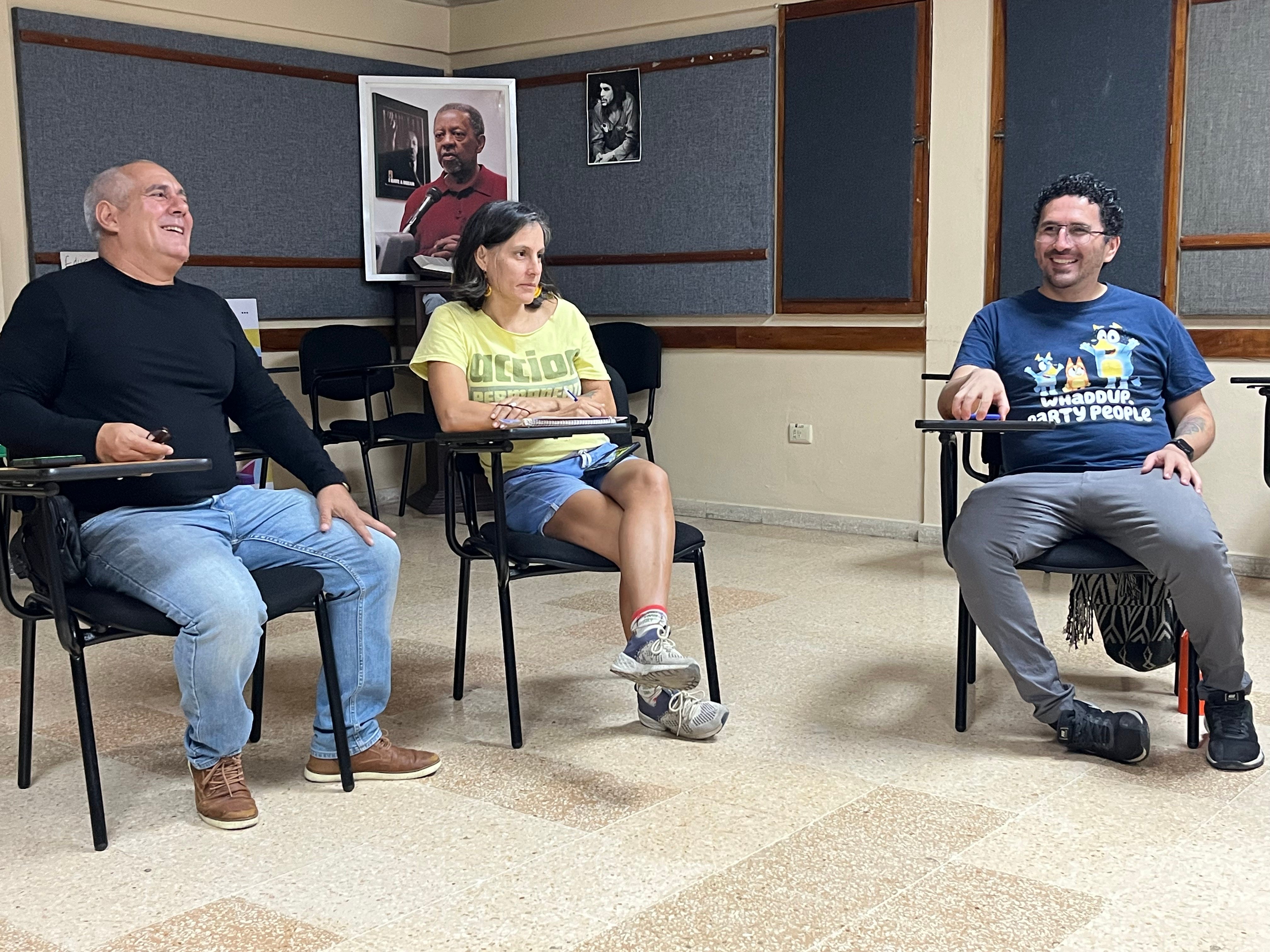
South Africa’s decision to invade Angola ultimately led to the end of the apartheid regime. Cuba defeated South Africa in a conventional battle with tanks and artillery. Namibia also gained independence as a result of the war, through a UN resolution. A treaty was signed in 1988, and the last Cuban troops left in 1991.
The Cuban operation was named “Carlota,” after an enslaved Black Cuban who led a rebellion at a sugar mill in 1843. Out of the 350,000 Cubans who served in Angola, only 2,000 died. There was only 1 undertaker who handled the Cuban remains to ensure the death toll remained secret during the war. Their remains were returned to Cuba in Operation Tribute, completed Dec. 7, 1989. Three or 4 bodies are still missing.
The Soviets only provided Angola a few advisors, infrastructure and logistical support. One of my fellow delegates, Hana, mentioned that Kwame Nkrumah, the leader of Ghana in the 1950’s and 60’s, was celebrated internationally but resented domestically for diverting resources to foreign interventions. She asked if Cubans had the same resentment of their government.
Piedra said there was more revolutionary fervor at the time and Fidel’s charisma convinced people to go along with it. Cuba aided over 60 countries around the world in that era. He added that Cubans are known for being “Fidelistas” more than socialists. But the benefits of the Angolan war are now obvious, especially with the end of apartheid in South Africa.
Piedra spent 3 or 4 months in training before flying to Angola. But he didn’t think twice about going to fight. He saw it as an adventure. However, the reality was much different. “Wherever there is a war, you won’t see anything beautiful,” he said. He traveled through cities with building facades collapsing and nothing inside, past trucks full of dead bodies. “Those are images that will be with you for a long time.” He was 19 when he returned and saw Cuba differently by then. He saw “the essence of things.”
Another delegate, Marika, asked if Cuba has been repaid for its assistance to other countries. Piedra recounted the oil tank fire that happened last year and how Mexico, Venezuela, Ecuador and other countries helped by sending oil and firefighters. He credited their solidarity for Cuba’s continued survival.
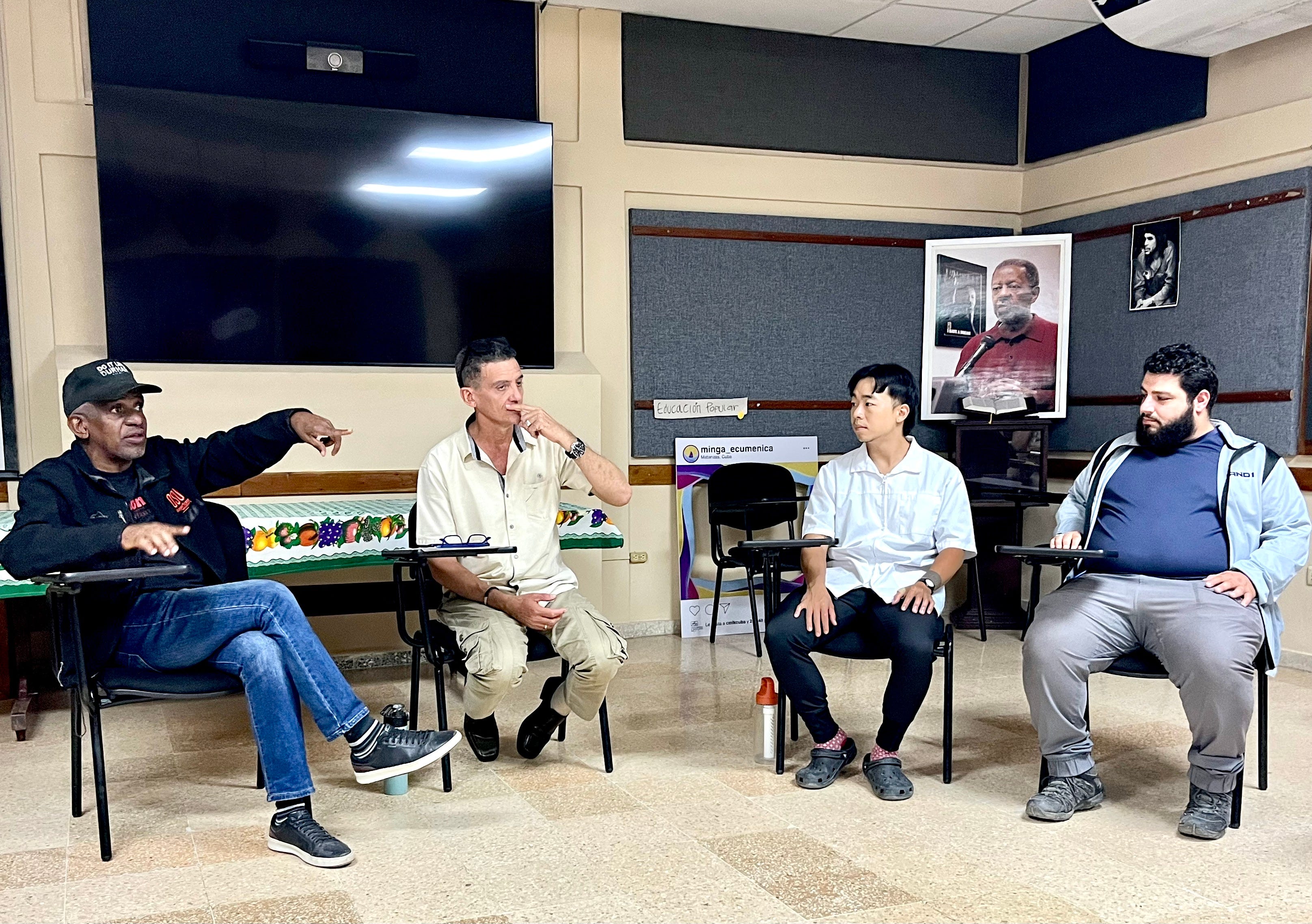
After lunch, we returned to the “classroom” for a discussion of Cuban healthcare. We spoke with 2 US medical students studying in Cuba and Dr. Wilfredo, the doctor who works at the Centro Martin Luther King, Jr. (CMLK). He said he saw 111 patients the previous Wednesday.
He’s from eastern Cuba and has 32 years of experience as well as a master’s degree in public health. He’s the son of a barber and homemaker and has worked in Niger and Saudi Arabia, as well as studying in Europe. After seeing the doctor training in those places, he was proud of Cuba. Even though it doesn’t have state-of-the-art technology, he thinks Cuba has a “clearer heart.”
The students were Hamza from Dearborn, MI, and James from Dallas. They’re in the Pastors for Peace program, an inter-religious foundation involved in over 80 countries (over 120 countries all-time) with 30,000 graduates. The program is free, while medical school in the US costs $300,000 to $400,000. It offers scholarships for 10 students, focusing on first-generation and low-income candidates.
Hamza and James started the program in 2021. James heard about it 5 years before applying. He waited until he felt he was ready. He worked at a hospital and was encouraged to apply by a doctor. His family didn’t have healthcare access. He was also a first-generation college student.
The program lasts 7 years. The first year is spent learning Spanish and taking a pre-med courseload in Spanish. The first 2 years they learn anatomy, physiology, basic sciences and public health, along with geometry and math to learn Spanish jargon. Years 3-6 are the clinical years, with the 3rd year focusing on your development as a clinician and the 4th year doing rotations in OB-GYN and pediatrics. Other training rotations include surgery, ophthalmology, public health and ENT (Ear, Nose and Throat). The 6th year is the intern year.
The interview process for ELAM (Escuela Latinoamericana de Medicina: “Latin American School of Medicine”) is 1.5 years, including orientation. Hamza compared it to a high school. The students stay in groups, unlike in the US. He and James have found it to be a thoughtfully organized curriculum oriented toward people and practice. US medical schools are often geared toward taking tests. They’re hyper-competitive and filled with members of the upper-middle class.
ELAM follows a bio-psycho-social model of health that incorporates the patient’s social context. It involves medical geography, covering the environmental effects on health. According to this model, 20% of health comes from individual biology, i.e., inborn qualities, while 50% comes from lifestyle.
Public health is covered in the first 2 years of medical school. Doctors in Cuba also serve as administrators and public health advocates. Students are sent to “polyclinics” near their school. Cuban doctors make house calls, developing personal relationships with their patients to provide a more holistic perspective and treatment. Dr. Wilfredo said that seeing the patient at home helps inform the bio-psycho-social assessment by evaluating the patient’s environment. Specialists rotate among these clinics. They also have hand-drawn maps on the wall of local houses and who lives there. The doctors are often from the neighborhood.
In Cuba, the doctor also functions as a public health advocate, whereas in the US these jobs are separate. Cuban doctors have 5 functions: treatment, rehabilitation, administration, teaching and research. Every medical facility is run by doctors.
US interns have their first contact with patients when they become official doctors. They have no experience with physical exams. Cuban med schools spend a year on physical exams, talking to patients and explaining medical charts to them. US med students are prevented from treating patients, while Cuban students are encouraged to assist doctors. Legal liability never falls on med students, not until they become doctors. Med school lasts 6 years in the rest of the world, but in the US it’s only 4 years.
The Cuban doctors’ strength is their “clinical eye,” identifying symptoms and how conditions present. Hamza attributed this to Cubans not being able to rely on diagnostics and complementary exams.
At the time of the Revolution, there were exactly 6,511 doctors in Cuba. Most left after the Revolution. The public health and medical program was established soon thereafter. Before the Revolution there were only 3 universities. Afterward there were 14, one for each province. Graduates immediately became teachers as well as doctors.
In 1981, the government declared healthcare free, accessible and guaranteed by the government. Clinics are embedded in each neighborhood with one family doctor and one family nurse. This idea came from Canada, Brazil and other countries. Dr. Wilfredo was part of the 5th “detachment” of this program, bringing healthcare to the entire country, including “the sticks”.
In 1988, Castro called for doctors to work in other countries, believing that sharing human capital doesn’t diminish the supply. The Cuban doctors go to remote areas where native doctors don’t want to go. ELAM was founded for this purpose.
ELAM has expanded beyond Latin America. It now has students from over 120 countries, people who wouldn’t be able to study medicine in their home countries. Cuba only asks that they return home to practice medicine in their own communities.
Dr. Wilfredo traveled to learn about the health systems in France, Holland and Scotland. In Paris, he thought the hospital looked luxurious. At the ER, there were facilities for patients to bathe before seeing a doctor if they smell or are dirty. He found this troubling, since any delay could be the difference between life and death. He saw the baths as torture devices.
In the US, they couldn’t believe that he could get to know his patients like family, because they only spent about 10 minutes with each patient. He thanked us for coming to Cuba as a reminder that we’re thinking of them and they’re not alone (although it seems like all we can do right now is think of them).
Edelso, our translator, said that ELAM started after Cuba sent doctors to help Central America following 2 hurricanes. Countries from outside Latin America asked to send people to the school, and it became global.
The outright expression of bias (e.g., racism) may cost a doctor their license. According to Dr. Wilfredo, the mixed racial character of Cuba mitigates racism. He said there are many Black medical teachers, including Black women.
Health issues in Cuba include drug abuse, like smoking. Dr. Wilfredo said that smoking is common, which is strange, since it’s an expensive habit. Smoking can also mask other drugs, by including them in the cigarette, like marijuana (cannabis indica). Cuba has an aging population, so chronic diseases are a problem, but transmissible diseases are not. Among young people, STD’s are a problem. There’s also poor health among young people who want to emigrate.
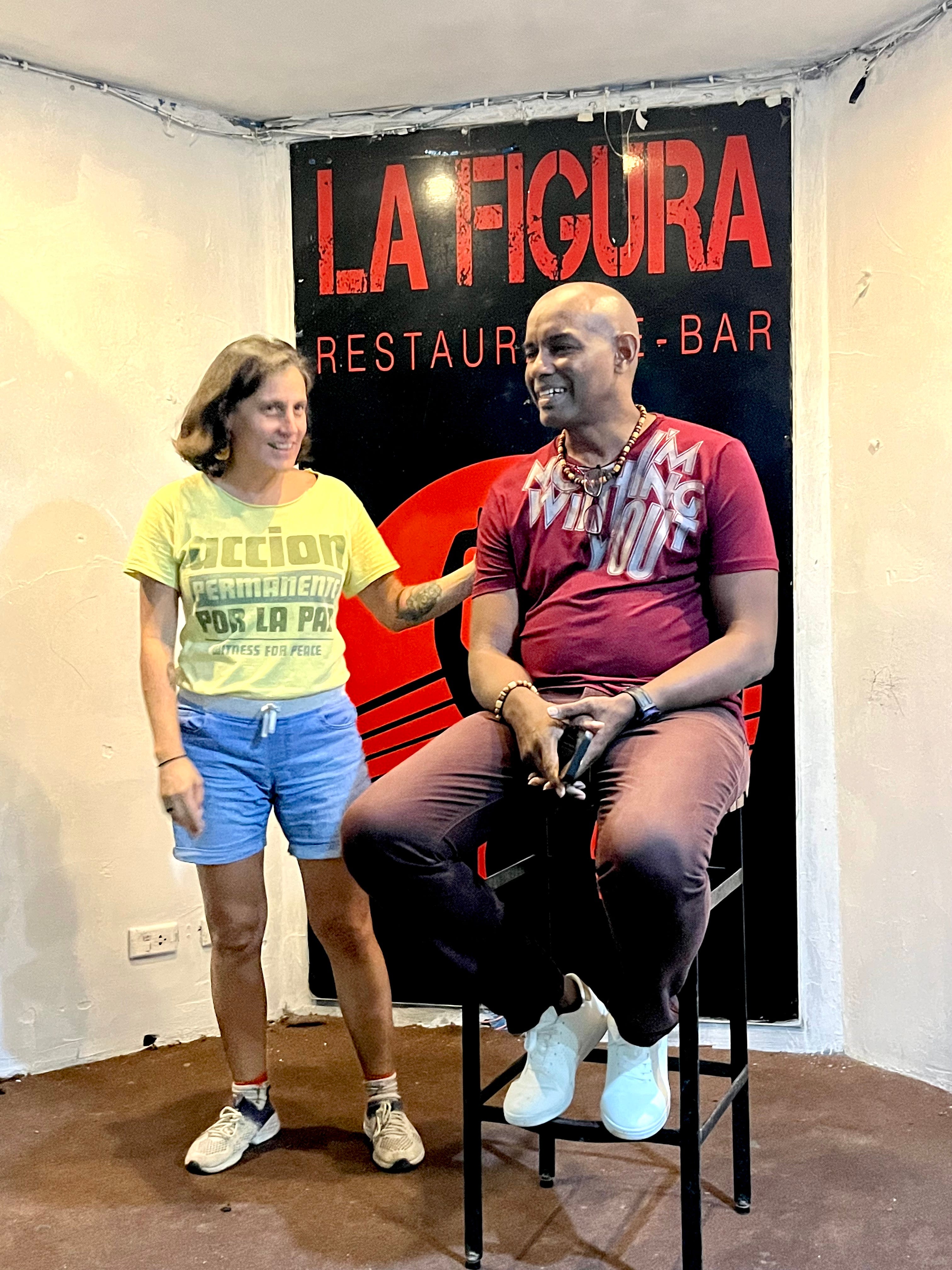
In the evening we went to La Figura Restaurante, owned by Raúl Diago Izquierdo, a former volleyball star. The restaurant hosts birthday parties, quinceañeras and family dinners.
Diago played for the national team from 1985 to 2001. He started playing volleyball at the age of 12 in 1977. Before that he played baseball and ran track. No one played volleyball in his hometown. He planned to register for running at his provincial school but got there too late, so he chose volleyball instead.
Commissions scout the country for athletic talent for provincial sports schools and national programs. They also scout coaches and referees.
After 3 years of provincial school, Diago moved to the national sports school. The students there split their time between athletics and academics. Academic success is required to play sports. Poor grades and failing tests lead to missing games. Athletes often go on to become physical education teachers. Some have become doctors or psychologists.
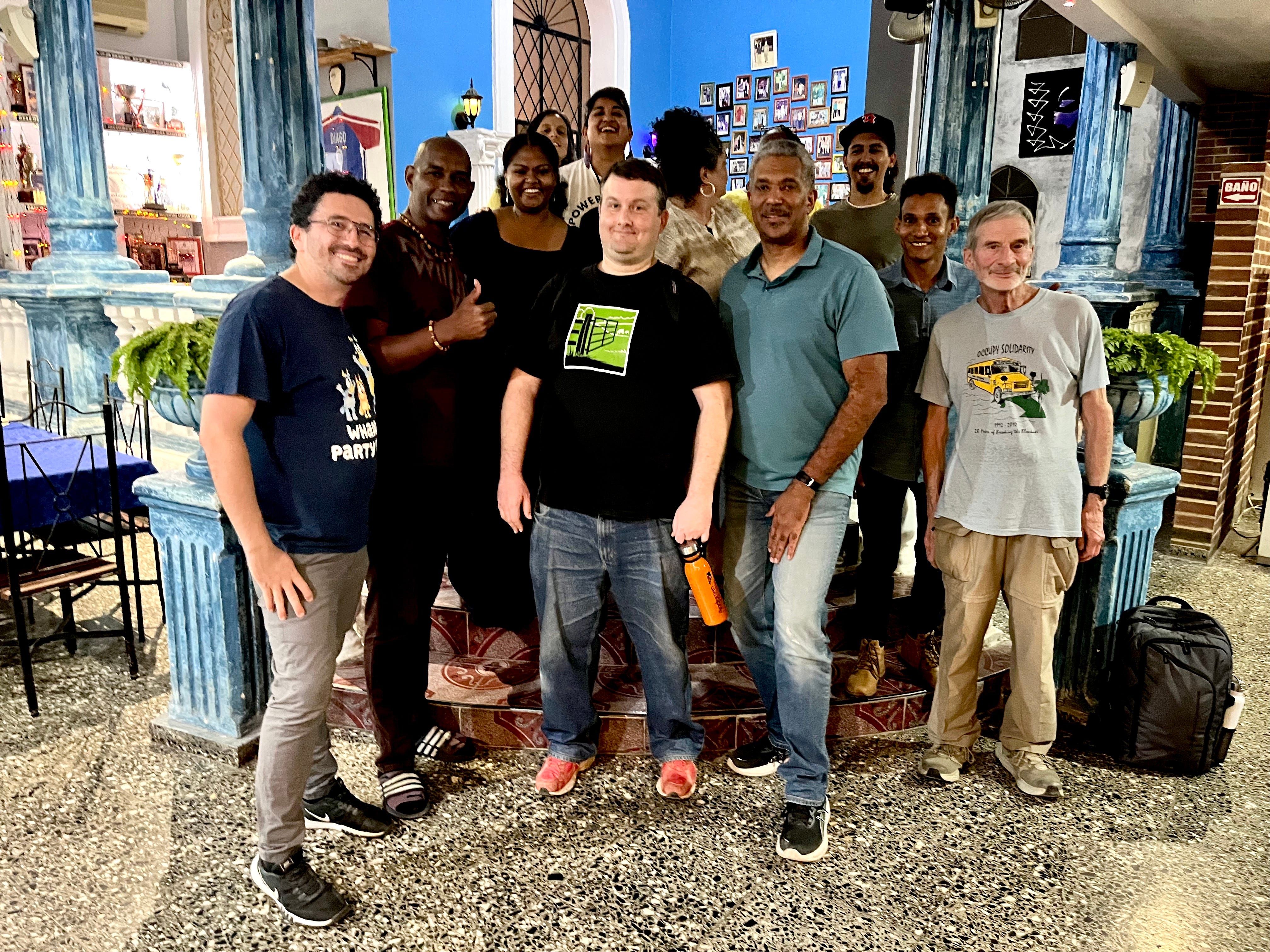
Diago made the senior Cuban men’s volleyball team at the age of 18. During his time on the team, they won the 1991 Pan American Games, beating the US, the only time Cuba has beaten the US in sports. They also won the 1998 Central American and Caribbean Games.
In 1990, the FIVB (Fédération Internationale de Volleyball: “International Volleyball Federation”) Volleyball World League was created. Cuba won the league in ’98 and finished 2nd 5 times. For Diago, the highlight of his career was beating Brazil, the defending champs, in the ’94 World League semifinal.
They were FIVB World Cup champs in ’89. The women’s team was also world champs that year. Both men’s and women’s World Cups were in Japan. The women’s team won first and left a letter for the men’s team saying that, if they won, the men would have to win too.
A cup was awarded annually based on the combined record of the men’s and women’s teams. Cuba won it 3 years in a row in the 90’s. The women’s volleyball team has won 3 world championships (1978, ’94 and ’98) and 3 Olympic titles (1992, ’96 and 2000). According to Diago, they receive support equal to the men.
We could see one of his pinkies was bent out of shape. He said that came from blocking spikes. His position was setter, so he didn’t get subbed out. He was named best setter in the world 8 times, playing in 3 all-star games vs. the Olympic or world champs, in Barcelona in ’91, Brazil in ’93 and Japan in ’95.
After his playing career ended, he coached the Cuban national team from 2003 to 2006 and served as president of the Cuban Volleyball Federation from 2006 to 2011, during which time the men’s and women’s teams had continued success. He then coached the Algerian men’s team, leading them to a bronze medal in an Africa-wide tournament after a 16-year drought.
Before the Revolution, Cuba only won a few Olympic medals. At the 1992 Summer Olympics in Barcelona, they won the 5th-most medals.
Every Cuban national team has a psychologist, doctor and physiotherapist. He said trainers should also be psychologists who understand the players. “You should visit their families,” he explained. “You should know their parents.” He knew his teammates on and off the court, enhancing the team’s chemistry and making it easier to develop camaraderie.
Many Cubans in volleyball have coached other countries to victories over Cuba, especially in the Central American and Caribbean Games. Economics have influenced Cuba’s sports performance. Results have suffered as the economy struggles.
Cuba has agreements with Japan, South Korea, Colombia and Venezuela to allow Cubans to play in their baseball leagues. But, in order to get into Major League Baseball in the US, Cuban baseball players often go to a third country, like the Dominican Republic.
Athletic compensation has increased greatly. They used to get just 10% of their contracted pay. Now they get 100%. The team also pays 10-20% to the Cuban sports federation. Corporate sponsorships have only just begun for Cuban athletes.
The Cuban volleyball team gets to compete against the best in the world, making it easier to keep those athletes from emigrating. Baseball players and boxers tend to leave to earn more money.
After the talk, we sat down to a private dinner at the restaurant, served by Diago’s family. Following the meal, 2 musicians showed up to give us a lesson in playing rumba.