Cuba: Day 3
The fourth entry in a series on my trip to Cuba 1 year ago.

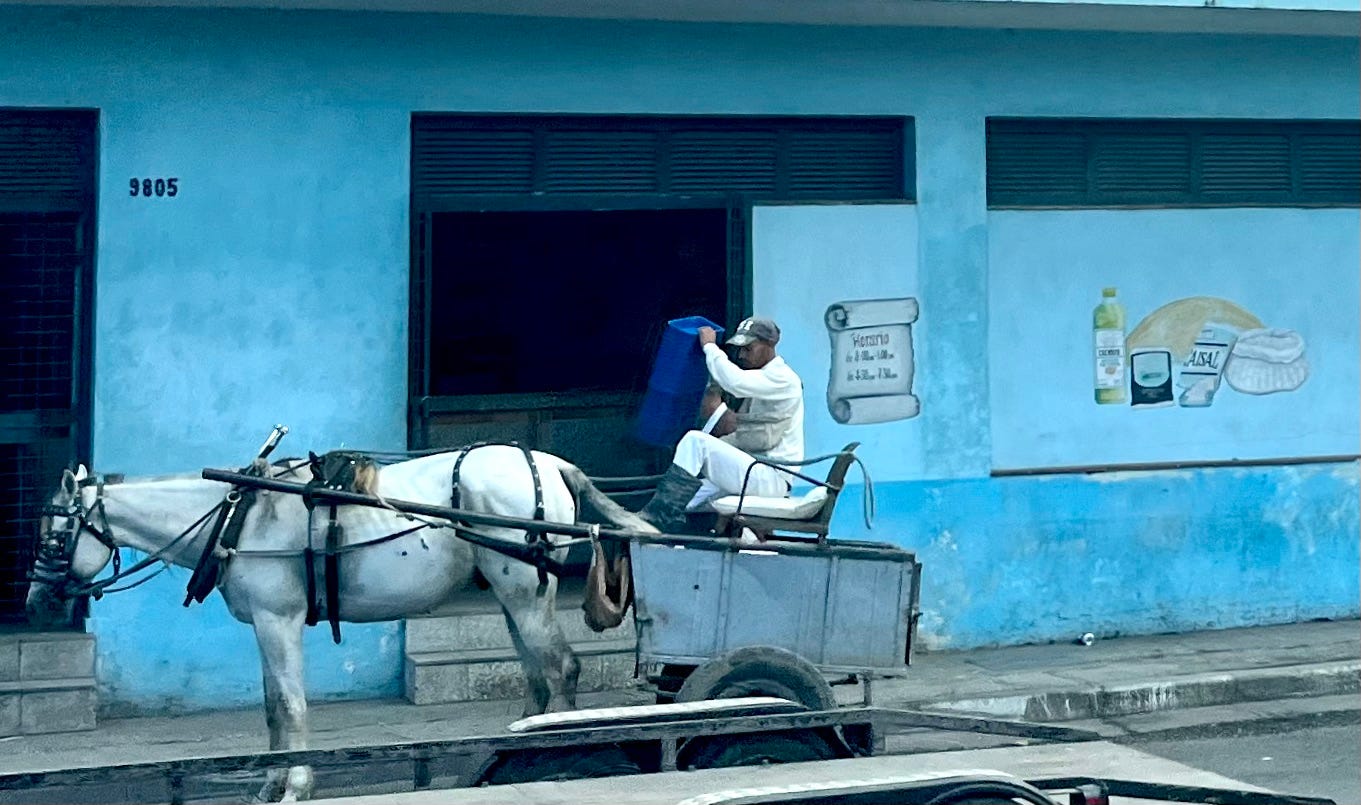
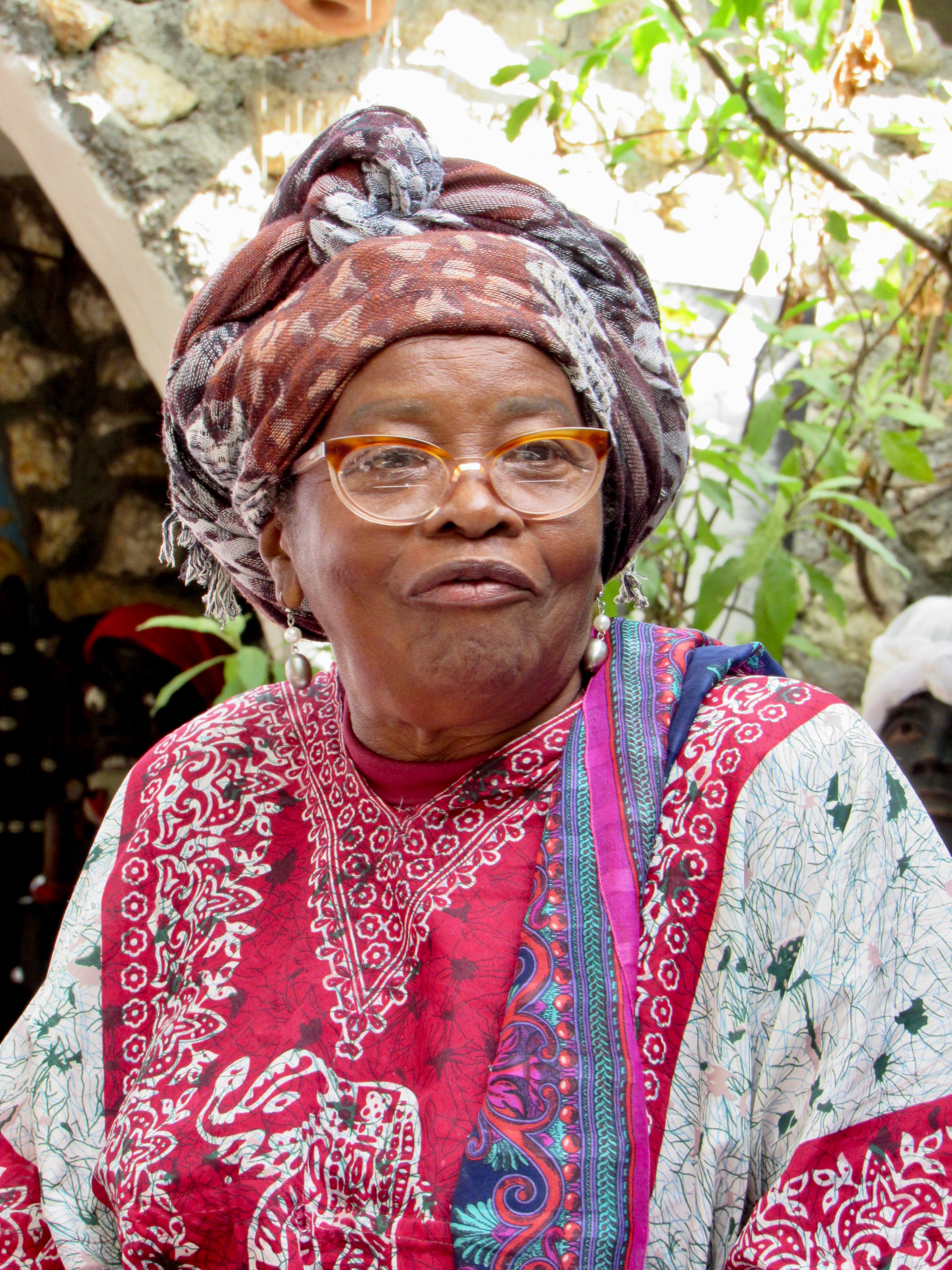
That morning we visited El Rincón de los Milagros (“The Corner of Miracles”) in a less residential, more wooded district of Havana. It was like the homes in the Oaxaca village I visited in 2016: a courtyard surrounded by a concrete wall with a mostly dirt floor and trees.
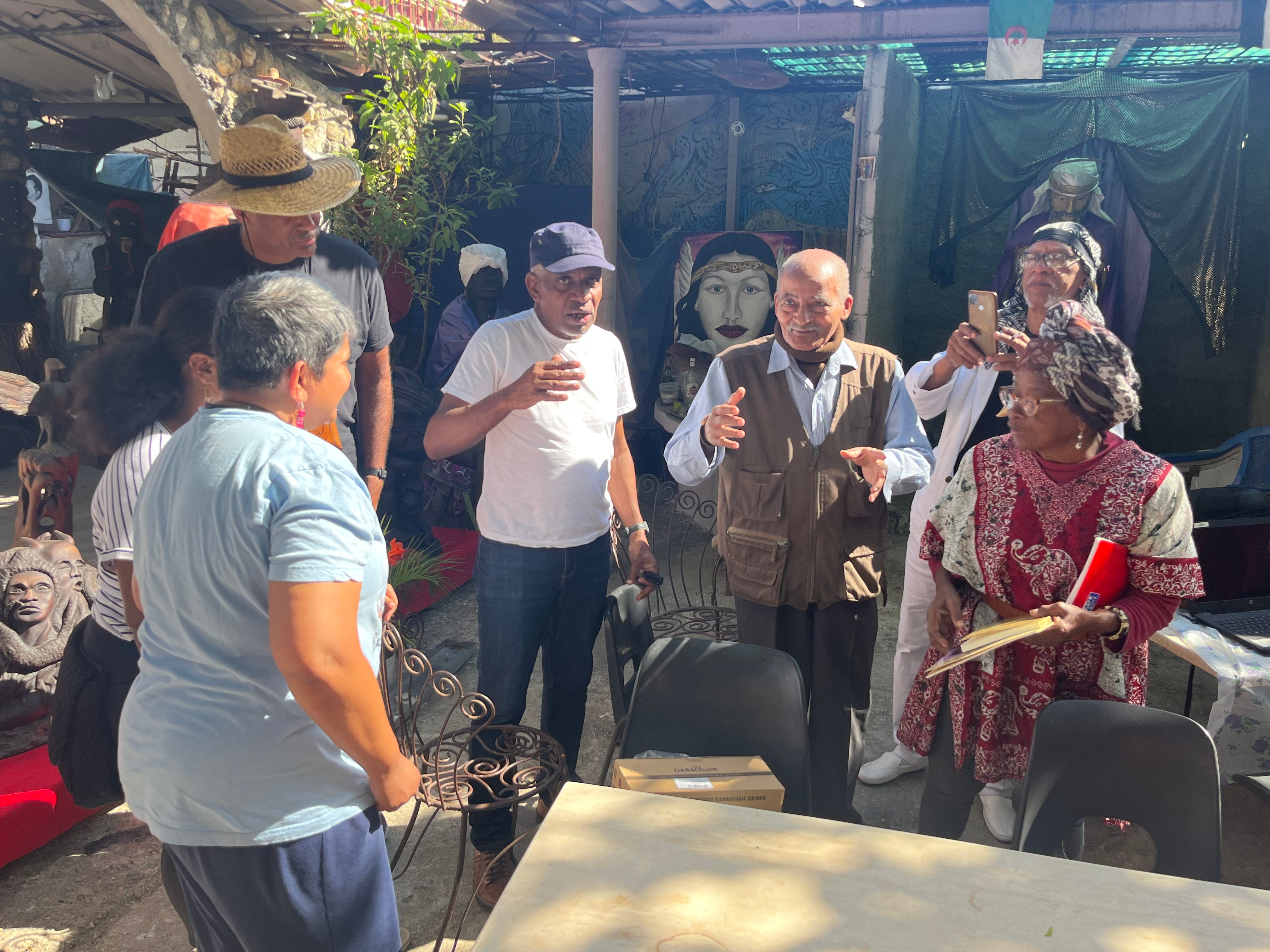
It’s a center for African-descended people, including Haitians, Canadians, French and US folks. There are about 1 million Cubans of Haitian descent (out of 11 million people in Cuba). The indigenous name for Haiti is Ayiti, which means “the land of high hills” or “mountains” in the Arawak language. Native Haitians settled eastern Cuba, offered the first resistance to Spanish colonization and warned the native Cubans about the Spaniards’ intentions: gold and other natural resources.
In 1512, the cacique (“chief/prince”) Hatuey fought a 3-month guerrilla war against the Spaniards. This was the first of many slave rebellions in Cuba led by Haitians. Hatuey was burned at the stake in Bayamo (a city in eastern Cuba) after being betrayed by one of his partners. Before the execution, a priest asked Hatuey if he wanted to go to heaven. Hatuey asked if the Spaniards surrounding him were going to heaven. The priest said yes, and Hatuey replied that he’d rather not go there.
The speaker cited this as an example of Cuban resistance to imperialism, comparing it to their struggle against the US embargo. José Antonio Aponte, a free Black artist, gathered Black people and Haitians in Havana and elsewhere in 1812 for a revolt against slavery and the colonial Spanish regime. They weren’t just fighting for the freedom of slaves, but also for farmers and other social strata. Despite this, in Cuban schools they still teach that the struggle for independence started in 1868.
When Aponte was captured, he had books about the leaders of the Haitian Revolution: Toussaint L’Ouverture, Henri Christophe, Jean-Jacques Dessalines and Alexandre Pétion. The first successful slave rebellion in the Americas, the Haitian Revolution ended in 1804.
In 1815, Simón Bolívar escaped Venezuela and went to Haiti. He acquired ships and weapons and returned to Venezuela but failed to liberate it. He fled to Haiti once more, and the Haitian president, Pétion, asked him to free the Venezuelan slaves. Again, Bolívar was supplied with weapons, ships and men. This time he won independence for Venezuela but could not free the slaves due to elite opposition.
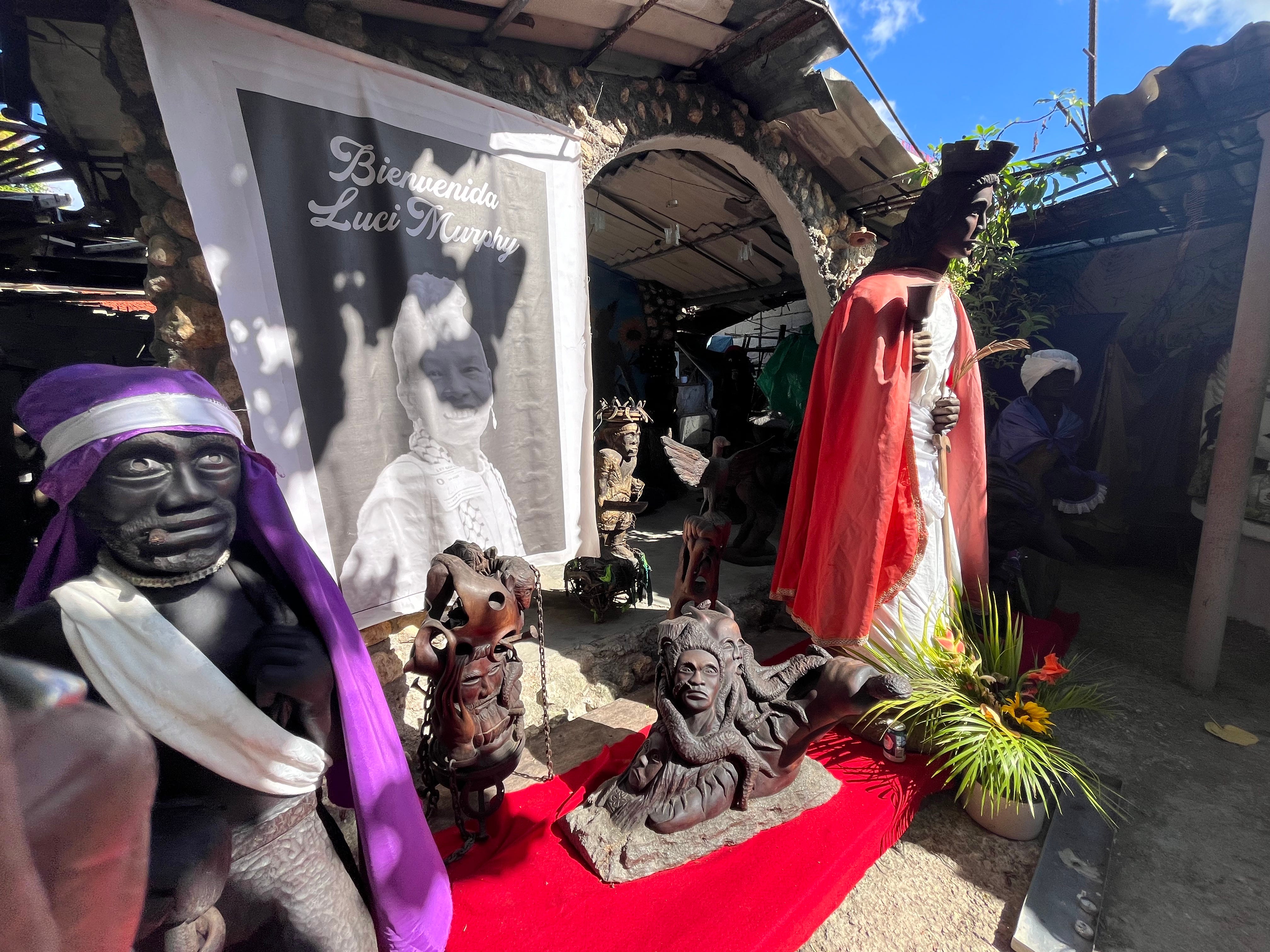
In 1895, Haitians fought for Cuban independence, including José Maceo and his brother Antonio, the 2nd-in-command of the Cuban Army of Independence. Rebel scouts found Black people speaking Creole, providing further evidence for the presence of Haitians in Cuba. Post-independence, during the Cuban Republic, a Haitian trade union leader in a sugar factory in Guantánamo, Chicha Cuba, was shot by the Rural Guard while marching in a demonstration in 1933.
Haitians have 3 names: their original African name, their French name (given by slave masters) and their Creole name (received in Haiti). Those who came to Cuba to work in the sugar cane fields were given their foreman’s family name in the official registries, because the officials couldn’t understand the Creole language. As a result, the census now asks what their ancestors’ family names were to learn what their names were before they were given the slave master’s family name.
One Haitian-Cuban patriot has a military medal named after him: Emilio Bárcenas Pier. He was a farmer born in Guantánamo to Haitian parents, who sought out the July 26th Movement guerrillas in the Sierra Maestra to join their rebellion. He was captured by the guerrillas and taken to Fidel. Fidel judged him to be honest and added him to his brother Raúl’s detachment.
Bárcenas was nicknamed “Tanganica” after a radio soap opera character who was tall and strong. He was in the vanguard of an assault on an army barracks but was wounded and died. Ramón Machado, one of the rebel leaders and a doctor, tended to him.
In 2012, the Day of the Haitian and Cuban was established as a national holiday on September 24, honoring the 500,000 sugar cane cutters who came to Cuba from Haiti and those who fought in the struggle for freedom. In Cuba, Haitians are stereotyped as poor, dumb, voodoo/witch doctors and runners/sprinters (like Usain Bolt) who can only dance.
Since 2012, researchers around Cuba have met every few years to discuss 120 research papers on Haitians in Cuba. In 2017 they created a chair for the study of Haitians in Cuba at Ciego de Ávila University. In 2018 at Holguín University the second departmental chair for Haitian studies was established. They’re trying to create another chair in Guantánamo.
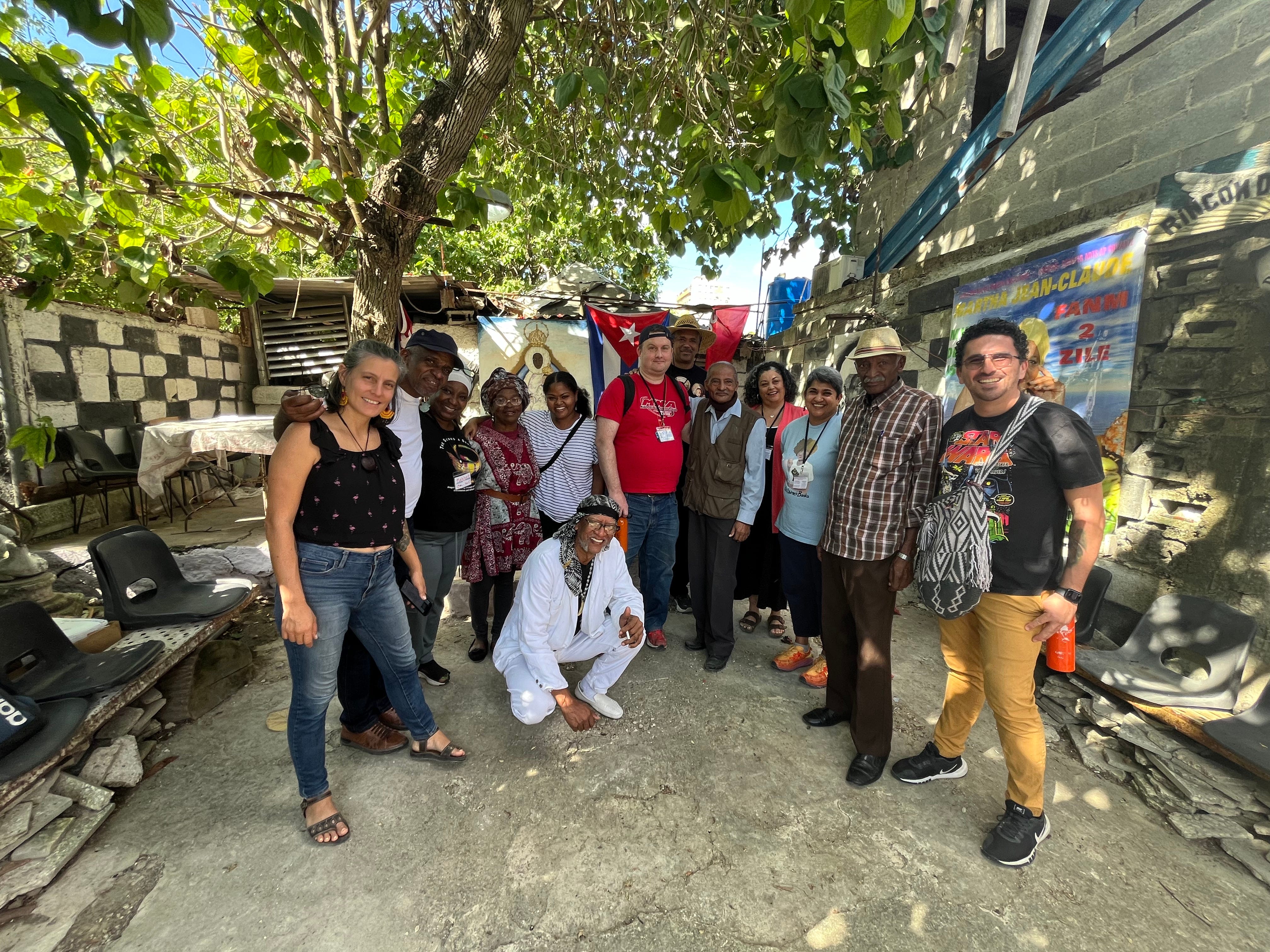
At one time, the oldest person in the world was believed to be a 126-year-old Haitian-Cuban, Benito Martínez Abrogán, who died in 2006. Haitian-Cubans are noted for their longevity, but Haitians in Haiti are not. Even after 200+ years, Haiti is still being punished for its revolution by the US, Canada, France, Spain, Switzerland, Germany and other countries.
After the 2010 earthquake, the Associated Press reported that only 1 cent of each dollar earmarked for Haiti actually went toward relief efforts. The male speaker went to Haiti after the earthquake and saw that the beaches, mines and factories are owned by foreigners, including from the US. He said Haiti is not a poor country in terms of natural resources, but its people have been impoverished. Haitians who get an education tend to emigrate because they can’t find professional jobs at home. According to the female speaker, some people in the US are funding a program for Haitians to study public health in Cuba.
Before 1959, Haitians in Cuba were marginalized. The woman remembered pre-Revolutionary racism she faced even as a little girl. After the Revolution, she went into the mountains to teach.
UNESCO has recognized pumpkin soup as a national dish of Haiti. The French forbade Haitians from eating pumpkins, making the soup an expression of patriotism after the Haitian Revolution.
El Rincón de los Milagros runs a school teaching Creole to non-Haitian Cubans. Creole is the 2nd-most common language in Cuba. After the death of Martha Jean-Claude, a Haitian-Cuban singer, the children at their school sang one of her songs on their own initiative.
The female speaker said that friends in the US bring materials for teaching Creole, but it’s not enough. They’re trying to assemble an archive of books and other materials. She developed her own educational materials to teach Creole and put it on a hard drive called “Marcelo’s Creole.” (Marcelo was another person at El Rincón de los Milagros.) The hard drive’s contents have been copied onto CD’s and DVD’s.
One man said his great-great-grandmother lived (enslaved) on the Bacardí plantation. She was raped by a Frenchman of the Bacardí family and gave birth to his great-grandmother.
Jovenel Moïse, the Haitian president who was assassinated in 2021, was planning to offer Haitian citizenship to Haitians born in other countries.
The male speaker said that Haitians trying to get to the US by boat or raft sometimes wash up on the Cuban coast. The Haitian Association in Santiago and Guantánamo takes care of those refugees. The refugees try to repair their boats or rafts and go on to Florida. Many Haitians who died trying to get to the US are buried in Cuba.
After sharing a drink with our hosts, we crossed the street to see a market. Unlike on previous trips, I was eager to try my Spanish on the vendors. One stand had a 10-year-old boy named Alessandro who spoke English with hardly any accent. I think he was wearing an Inter Miami jersey, maybe Messi’s. We talked to him as his mom and grandma looked on, beaming with pride.
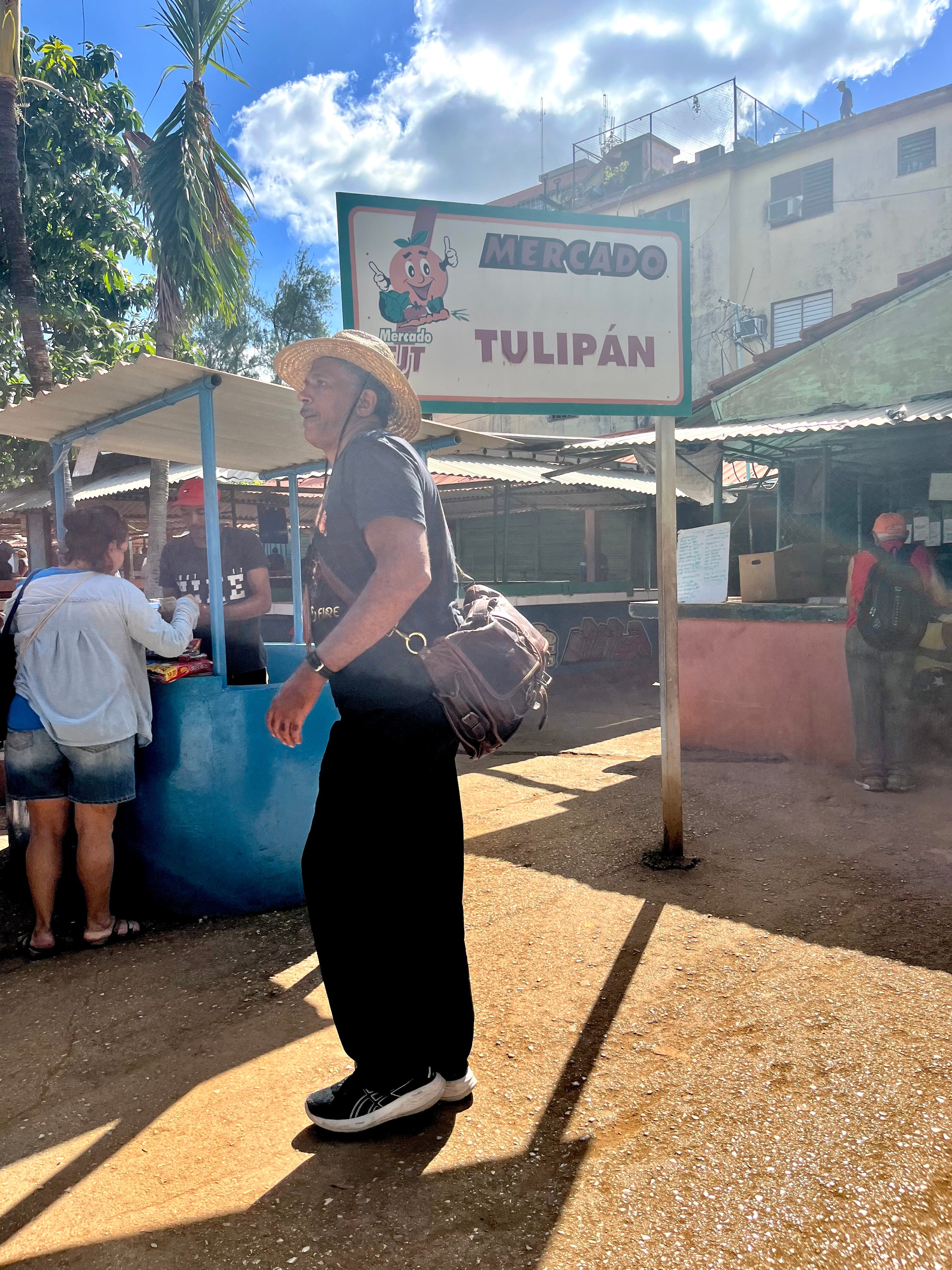
I bought a set of wooden kitchen spoons from them for a few bucks. The exchange rate at the time varied from 200 to 300 Cuban pesos to the dollar. US dollars were welcome pretty much everywhere, given the weakness and volatility of Cuban currency.
Thence we repaired downtown to a fancy restaurant below street level for lunch. It felt like the other patrons were annoyed by us, but that might’ve just been my insecurity talking. We were kinda loud and not dressed as nicely as the other patrons. I couldn’t tell if they were tourists or Cuban.
I usually had seafood at the restaurants: shrimp, swordfish or bonito. Ropa vieja, which is a national dish of Cuba, was a common menu item. There didn’t seem to be any lack of meat at the restaurants or CMLK, as I thought there might be. People asked about that after I got back to the US. I think every meal we had included meat, except maybe breakfast, but that always included eggs, so we weren’t protein-deprived. They may’ve done that especially for us Yanquis, but I didn’t get that impression.
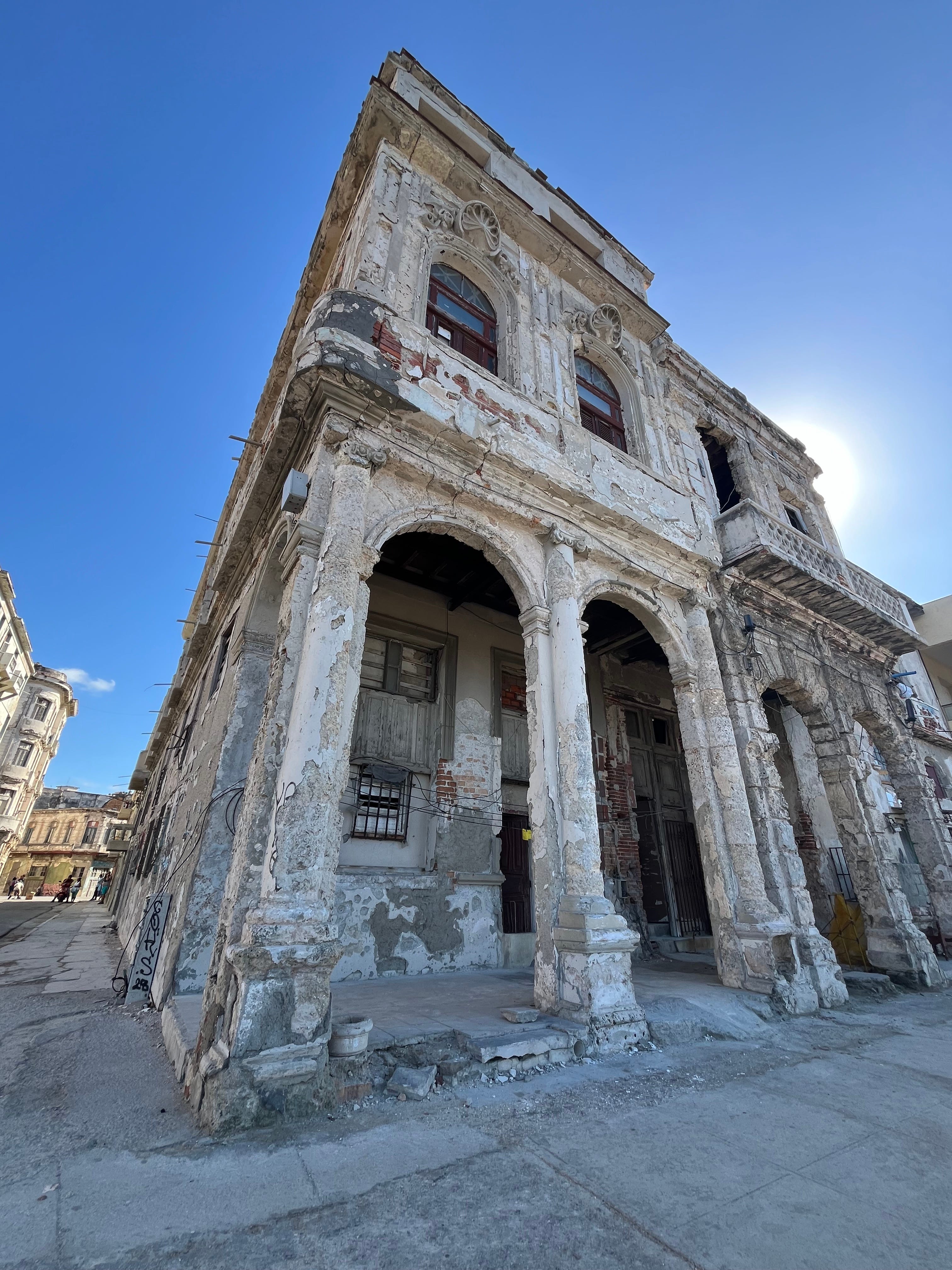
From the restaurant we walked a few blocks to the waterfront, where we took pix of each other and the old Spanish fort across the harbor. The wear and tear on the buildings was especially apparent here along the shore. From my First World perspective, it almost looked like a war zone.
Our next stop was a small city park where teenagers were playing soccer. There we met Elias (last name withheld), a Santería practitioner who took us on a tour of the neighborhood and told us about Santería. He was in the midst of a 9-day purification ritual which required him to dress all in white. He followed that to a T, including his shoes.
There were bunches of bananas in plastic bags lying around the trunks of the ceiba trees in the park. They were left there as offerings by Santeros (Santería practitioners). Santeros use the bags to hide their religion from the authorities. Elias said that “ecological” or “green” Santeros want to eliminate the use of plastic bags.
Before the Revolution, the government considered Santeros devil worshippers. After the Revolution, no member of the Communist Party could practice religion, leading to social segregation. “It was not until 1991 that we changed from being an atheist country to a secular one,” Elias said. But there’s still bias against Santeros. He said he could be denied certain jobs if they know he practices Santería.
“This religion is like a service,” he explained. “You can use it without being initiated and without any commitment – like a doctor, like a lawyer.” He said Cubans of all faiths enlist Santeros to deal with personal problems, especially health issues. The first step is a consultation to find the spiritual source of the problem and the spiritual force you need to invoke to achieve your desired goal.
Santería is a hybrid of Roman Catholicism and West African religions, especially that of the Yoruba people. It is non-centralized, non-institutionalized and non-proselytizing. It has no dogma, no conception of sin and no holy book. It’s based on oral tradition and is more properly called Regla de Ocha Ifá.
Santeros believe life doesn’t end, that death is just a transition. They have no concept of heaven. The living, dead and unborn are all in the same family. You’re responsible for your own development. You must sacrifice to be in balance with the malevolent and benevolent forces in Nature. Animals are complementary to humanity.
“Blood is a symbol of the pact of life between the supreme being and humanity,” Elias said. Animal sacrifice is part of Santería. Those who slaughter animals must undergo a ceremony to receive a license. Meat is cooked and eaten in a ritual wherein they gather the whole community. The meat absorbs hidden properties. Elias and his friends sought out houses of Santería for meat during the Special Period (the early 90’s, after the fall of the Soviet Union, a time of extreme privation).
The ceiba tree is sacred to Santeros, hence the bags of bananas in the park. To some, the trees are the counterpart of the baobab tree in Africa, which held religious significance for many enslaved Africans. The ceiba tree represents longevity and resistance. The 4 main branches of the tree point in the cardinal directions. In Santería, it joins the deities of rain and winds. “It’s the house of the spirits, the house of the divinities and is a deity itself and is related to wishes,” Elias said. The first Catholic mass in Havana was held in the shadow of a ceiba tree. Every November 16, people walk around that tree and ask for good fortune.
Palace of Rumba, an old music club near the park where our tour began, had been closed for more than 10 years. Elias said rumba was the Africans’ sacred music in disguise. Because they were not allowed musical instruments, Africans used everyday items: guava skins and barrels of oils and wine. The conga drum was originally a barrel. Rumba has always been considered the music of the poor, “savage people.”
Next, we headed for a house of Santería. “We don’t have temples as such,” Elias said. “We have houses.” We sat in the front room, which was full of statues, as he explained the significance of Santa Barbara and African deities. There were people cooking in the kitchen as we toured the house.
“Santería is a field where marginalized people are legitimized,” he said. “It’s a field where Black women found social recognition. It’s a field where the LGBT community found shelter when they were rejected by communism.”
The Cuban Constitution of 1902 declared racial equality. But, despite Revolutionary efforts, racial prejudice persisted. In 2006 the government admitted racism was still a problem. 2019 marked the start of a national program to erase racism. Elias showed us one of the few statues of a Black Cuban in Havana, a general in the War of Independence, José Quintín Bandera Betancourt. According to Elias, he was killed by his White officers in 1906.
Santería originated with the Yoruba priests and priestesses from Nigeria who were enslaved in the late 18th and early 19th centuries. It’s a hybrid of the “spiritism” of the Yoruba and the Spanish form of Roman Catholicism. The name “Santería” was originally a pejorative used by outsiders to describe the African worship of Catholic saints.
St. Barbara is identified with Changó, the god of fire, thunder, music and dancing. On December 4, people go to mass in the morning to honor St. Barbara, then go to houses of Santería in the afternoon to play drums, dance, drink rum and smoke cigars dedicated to Changó.
Some houses of Santería require Catholic baptism before you can be initiated into the mystery. Elias sees that as evidence that some Santeros still need the permission of White people to practice African traditions.
Santeros believe in a “highest consciousness,” similar to the Abrahamic god, a supreme being who created the world with the help of other deities. After creation, he retired and left the orichas (divine spirits) on earth. 200 orichas were brought over from Africa, but only 10-20 remain. The current collection of orichas is a Cuban invention or reformation.
“Orichas are natural forces, aspects from nature,” Elias explained. “Orichas are anthropomorphized spiritual entities. Orichas serve as organizing principles for understanding the world. Each oricha has a domain on earth, physical manifestation, psychological correlative in human minds and other symbolic distinctions. Orichas are frequencies of energies produced by the natural forces in a natural environment. Being initiated into Santería is being in alignment with one specific oricha that you were born with that oricha assigned.”
“In blue color we have Yemayá, goddess of the ocean, maternity, fertility, the mistress of the surface of the sea, the mother of the world and everything therein,” Elias said. She protects families and unifies people. We’re all children of her “because we’ve all swum inside the belly of a woman for 9 months. In yellow color we have Ochún, goddess of love, rivers, the active type of joy, pleasure, happiness, prosperity.” She protects wombs and sex workers. In black is Oyá, goddess of wind and hurricanes, who watches the doorway between life and death.
In a 7-day ceremony (because of the significance of the number 7 in Biblical numerology), the initiate remains secluded in a room in a house of Santería while Santeros determine which oricha is the source of the person’s energy. Besides your primary oricha, you’ll receive an auxiliary oricha. The supreme being is the wielder of the universe’s energy, or aché. Once the aché has entered the person’s ori (head), they become a bride or junior wife of the oricha. Elias was initiated in the frequency of energy identified with the oricha Obacalá. Initiation costs $2,000 in Cuba ($5-10K for foreigners) and around $25,000 in Miami.
After you receive the energy, you get a magical receptacle for it, a stone. White on the top of the stone symbolizes Obatalá, the owner of the heads of human beings, the god of poetry, the intellectual world and peace. Obatalá was the first oricha created. He molded the human body from clay. He owns everything in white, is depicted as a white pigeon (dove?), the mountain, light from the sun and the one who brought the light.
For 1 year and 7 days, you have to follow certain rules, like dressing all in white, which symbolizes life after death, the spiritual world and purification. This was inspired by the Catholic custom of dressing in white for baptism. Slaves in Cuba originally wore just one piece of white cloth. This is also to honor Obatalá. During this time, Obatalá is the overseer of your deeds.
During this time, you can’t shake hands with anyone or be photographed. For 3 months you can’t go out after 6pm or before 6am. After 3 months you can’t go out after midnight. You can’t see your face’s reflection in the mirror or receive the image of the sun at noon or the moon at midnight. Women can’t wear makeup or perfume or use shampoo or anything with a strong odor.
Rather than divination, they “interpret the holy information from the universe” by Ifá, the casting of cowrie shells. Ifá was introduced to Cuba at the end of the 19th century. It’s called a digital oracle because it uses binary code. It’s associated with the oricha Orula, whose colors are green and yellow. Orula’s Catholic counterpart is St. Francis of Assisi. Babalawos (“fathers of secrets”) are representatives (priests) of Orula on Earth, and, in Cuba, they must be heterosexual men.
In 1959, when Fidel gave his first speech in Havana, a white dove landed on his shoulder for 2 hours. People took it as a sign he was “the Chosen One.” Some said Fidel put food on his shoulder to attract the dove, but, even so, it was a potent use of symbols to win popular support. Gerardo Machado and Fulgencio Batista, pre-Revolutionary Cuban leaders, also used Santería symbols.
Elias recommended 3 books on Santería: Santería Enthroned by David H. Brown, Flash of the Spirit by Robert Farris Thompson and The Altar of My Soul by Marta Moreno Vega. Moreno Vega also made a documentary called Cuando Los Orichas Bailan Mambo (“When the Gods Dance the Mambo”).
He then took us to El Callejón de Hamel. It’s a pedestrian street that functions as a community center, hosting rumba on Sunday, children’s activities on Saturdays and LGBT activities. They also have Cuban rap, reggae and traditional musical performances. It was created in 1990 by Salvador González Escalona as an “act of transgression and transformation of the urban space in order to visualize and legitimize these traditions.” González started the project without government permission, which, according to Elias, he never would’ve gotten if he’d asked.
El Callejón de Hamel is also filled with art. We checked out the galleries located along it. I bought a “Rumba Con Salsa” CD from a guy for $10, a decent price in the US, but wildly inflated for Cuba. Feli said I didn’t have to pay that much for it, but I didn’t mind. I figured the guy selling it could use the money. (Just as well: when I brought it home, it didn’t work.)
Here was where we bid adieu to Elias. I saw him stick the ragged stub of a cigar in his mouth as he turned to walk away. I don’t know if that’s allowed during his purification ritual, but I didn’t have the guts to ask.
We returned to CMLK to rest and have dinner. The evening’s entertainment was a trip to El Sauce, an outdoor music and cultural venue. On Sunday nights they have Discotemba; according to our hosts, temba means “middle-aged.” The 2 DJ’s on stage were spinning tunes for folks my age (and the age of most of the delegates). Of course, the target demographic was still Cuban, so it was mostly Latin pop, reggaeton and the like. It took me a while to hit the dance floor.
The DJ’s were older guys with white and grey beards. We called them Marx and Engels (or somebody did). I thought that would be a great name for a DJ duo. (Or maybe I’ll use it for my yet-to-be-determined solo music project. Stay tuned!) All us Norteamericanos hit the floor for the Black Eyed Peas’ “I Gotta Feeling.” It’s not my favorite song, but I do think it’s pretty good. It came out 15 years ago, as my time as a hipster was coming to an end. Even back then I enjoyed it, especially for the “l’chaim”.
I let loose and actually enjoyed dancing. I told Marika I only dance about once a decade, forgetting that I had danced on my last night in Honduras in 2019. My moves got a much better reception this time, one of the benefits of dancing with people closer to your own age or older. Feli and Nati danced almost the whole time we were there, which was about 3 hours.
We paid 600 pesos each (about $3) to get into the VIP space at the back of the venue with a bucket of beers. Nati said the VIP space was new. (Feli lent me 200 pesos for my spot, and I never paid him back! I’m sorry, Feli! The stupidest part is I was trying to find the perfect, i.e., discreet, time to repay him at several different points for the rest of the delegation, and then I just forgot. That’s Peak Mickey. If that anecdote were a sitcom, it’d be called That’s So Mickey!)
I enjoyed this. It’s full of the kind of hidden history and exotic lifestyles and quirky facts that are my favorite things to read about. About the white dove that sat on Fidel Castro tale - that reminded me of something from the first Bernie Sanders campaign that I had forgotten (and I can’t believe I forgot it!) Remember this? https://youtu.be/FV2wCXKgG1E?si=WjZMfnvikjWqTCZ2