Cuba: Day 2
The third in a series on my trip to Cuba 1 year ago.

Saturday 12/7
In the morning we met with Joél Suárez, the son of the founders of the Centro Martin Luther King, Jr. (CMLK). His parents were pastors at Ebenezer Baptist, the adjoining church that founded the CMLK. He looked like an aging radical with his salt-and-pepper beard. We met in the classroom-lookin’ room on the 2nd floor of the building across the courtyard from the lodging and cafeteria building at CMLK.
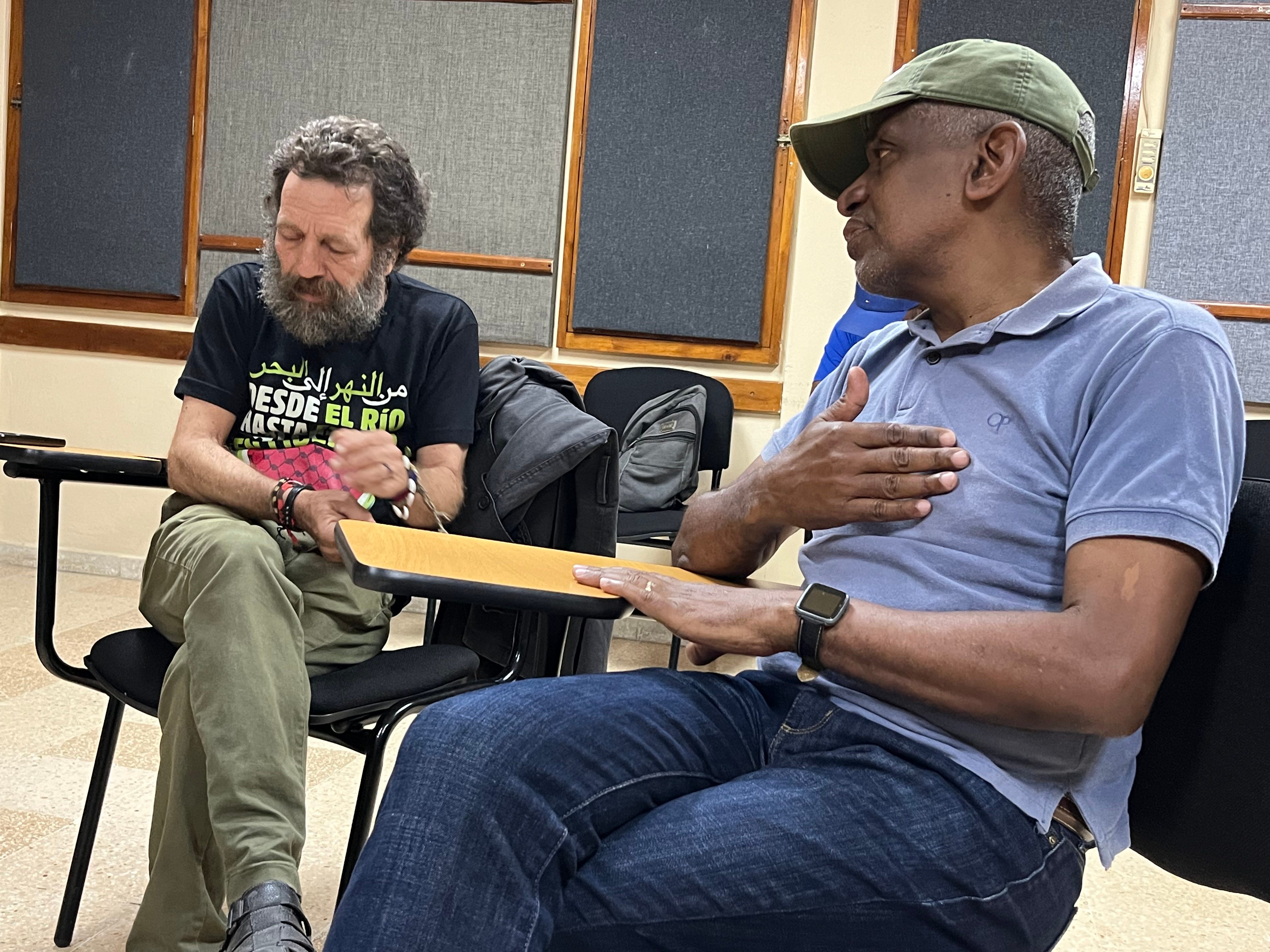
The CMLK was founded in 1987. Suárez served as director until 2022. He considers the CMLK the “child” of the church and connected to Baptist tradition, not to be confused with the Southern Baptist church, which he called “terrible.” All the Baptist traditions came to Cuba at the end of the 18th Century.
After Cuba’s War of Independence from Spain in the late 19th Century, some Protestants left the country. Roman Catholicism was the only religion allowed in Cuba until the 1950’s. In that decade, these “Patriot Missionaries” returned to start Protestant churches, including Ebenezer Baptist. But US missionary boards took away the Cuban missionaries’ “transplant” churches. The US churches were anti-communist and not interested in theology that recognized social responsibility.
According to Suárez, the Cuban Revolution of the 1950’s wasn’t just about changing who was in power but about transforming society. In 1961, when Fidel announced the “socialist character” of the revolution (just before the Bay of Pigs invasion), many Christians felt that God had left Cuba for Miami. But most of them stayed in Cuba to await the “Second Coming” of the US military to overthrow the communist government. When that failed to materialize, they embraced politics. Others sympathized with the Revolution’s emphasis on social justice.
Suárez’s parents and church were isolated from the rest of the world and, as a result, didn’t know about Liberation Theology and other social justice movements in Christianity. They began to read the Bible without the US missionaries’ lens. They discovered MLK and the process of “conscientization”: acting because of faith.
The church was in a poor neighborhood and culturally White, but Suárez assured us it wasn’t racist. They reached out to their Black neighbors, adding drums to traditional piano music. Their friends in Spain mailed them books on MLK a few pages at a time.
They thought the world was evil, so Christians should stay out of politics. Contact with Mexico in the 1970’s introduced them to Liberation Theology and the Black Liberation theory of James Comer and Cornel West, as well as Harvey Cox’s theory of secularization. The church was not a space for socialists or anarchists. It welcomed members who disagreed with the Revolution and was limited in what it could do.
By comparison, CMLK allows for more freedom to do social work. In the 60’s and 70’s, Cuba was isolated, which led to what Suárez called its “carnal” relationship with the USSR. It was an asymmetrical dynamic in terms of their comparative geopolitical strength. In Joél’s opinion, it “marred” Cuba’s social development. The Marxism exported by the Soviet Union was dogmatic, atheist and authoritarian. Cubans ultimately rejected those characteristics. But any criticism of the USSR was seen as support of the USA.
According to a Catholic scholar, the greatest challenge of the Revolution was how to have a “parliament in the trenches.” In other words, how could they maintain a democracy while they were under siege? In the 1980’s, the economy was better, but things still weren’t great. There was a song that said, “I want to live in the news program,” because the Cuban news shows made things sound better than they were.
In 1986, the government introduced the “Process to Rectify Errors and Negative Results.” It was the founding of social debate, which was necessary to sustain the Revolution as the USSR collapsed. (The CMLK is in the Ecumenical Faith Network and the Popular Education Network.) Popular education was necessary to recover popular participation as the core of the Revolution. The popular education is all voluntary. CMLK also does international solidarity work.
Suárez considers this moment to be another turning point like the 1990’s, when the fall of the Soviet bloc required mass mobilization. But back then they still had an “ethical relationship” to the Revolution and could weather the crisis. His son was born in 1988 and grew up in a socialism of scarcity, but he was still able to study classical ballet and now does contemporary dance. He takes free healthcare and education for granted.
Young Cubans don’t see capitalism as bad because they have little experience with it. Like the proverbial fish that doesn’t know what water is, they’re oblivious to the benefits of socialism. He wonders how they can recreate the values of the Revolution in this context. Adverse circumstances can develop solidarity and a sense of justice.
His daughter is in arts school, where they study common subjects in addition to the arts. He mentioned an art installation made by his daughter and her friends in solidarity with Palestine (called “Contradictions and Contrasts”). Education is compulsory until the 9th grade. They have free lunch, but it’s not enough.
Racism still exists, but there are programs to create anti-racism policies and gender equity. Even though the laws have been changed to reflect this political shift, they aren’t necessarily lived out. He said it’s hard to foster political and ecological consciousness when people have to cut down trees for firewood.
Many young people are emigrating, and many adults say the youth are lost, but, as Suárez said, the reality is complicated. They showed solidarity during the pandemic. The youth need to make the country they want. He wants them to create a just and revolutionary society. To meet this goal, he thinks it’s crucial to have a pedagogy that meets the challenges of the digital age.
Today, Cuba is in a terrible economic crisis. Obama relaxed the blockade, only for Trump to tighten it, creating a culture of fear. The Cuban government used a lot of resources to protect the people. Biden made no changes to Trump’s embargo regime. A lack of fuel for power plants has led to rolling blackouts. Cuba is also short on food and medicine.
During his first term, Trump implemented over 200 measures against Cuba. With the (at the time, recent) nomination of Cuban-American Marco Rubio as Secretary of State, it’s feared his second term will see even greater tightening of the US embargo. (These fears have been borne out in the past year, especially by the recent seizure of a Venezuelan oil tanker that was headed to Cuba.)
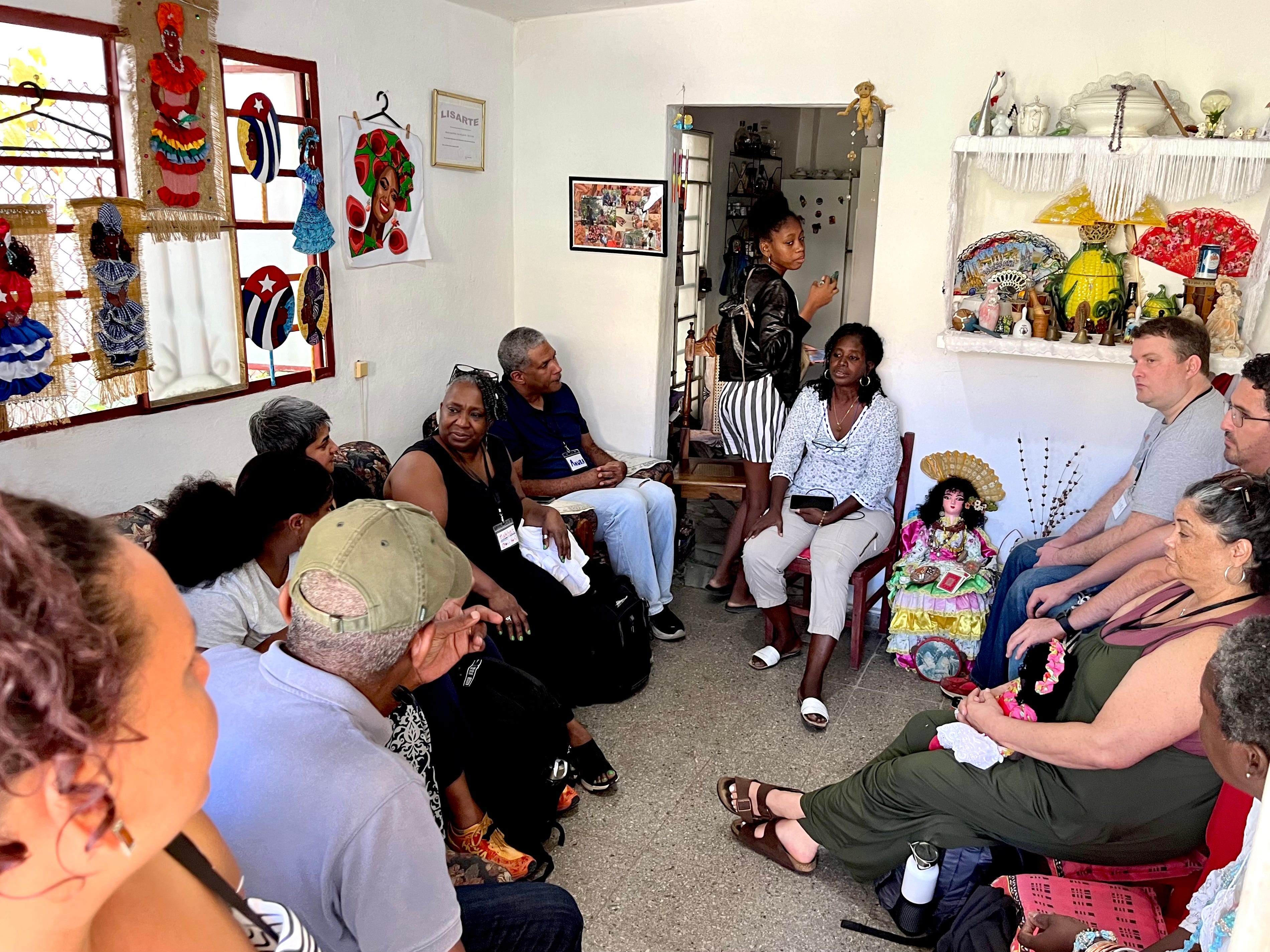
Following our discussion with Joél Suárez, we drove to Muñeca Negra (“Black Doll”), a community project to empower Afro-Cuban women. We sat in the front room of a house as the women explained their organization. They teach other women and girls to make dolls and other handicrafts for sale. We saw their wares in the dining room and upstairs and bought some items. Each of us was given a necklace with the face of an Afro-Cuban woman in a headwrap. The group’s matriarch personally tied the necklace around each of our necks and gave us a hug. It was like being knighted by the Queen, but on a much warmer, humbler scale.
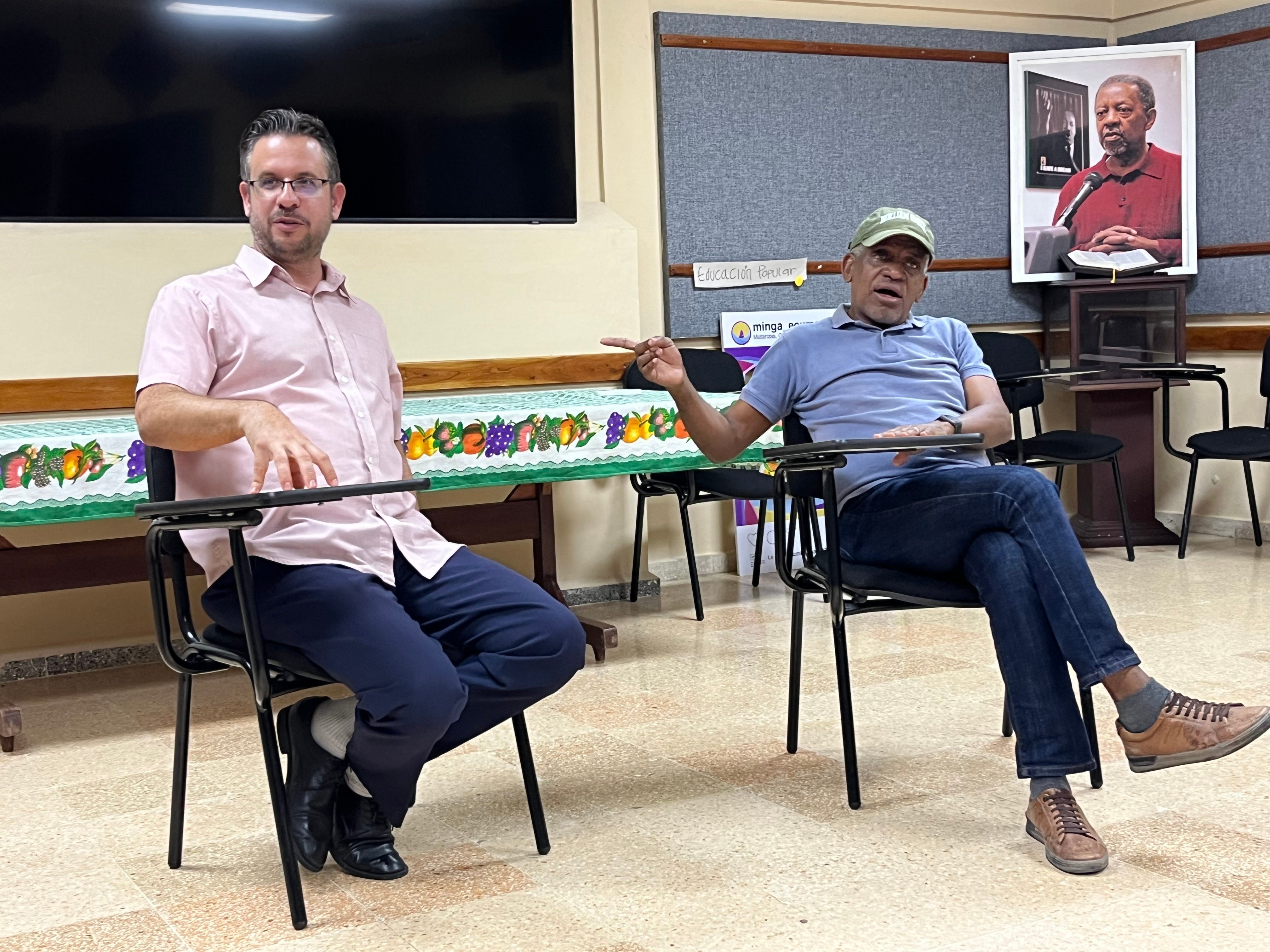
In the afternoon we returned to the classroom at CMLK to hear from Elier Ramírez, sub-director of the Fidel Castro Center, a historian. He said we can’t talk about Cuba without talking about the US. He wrote a book about what he called “the 8 myths of US-Cuba relations.” The myths surround the origin of the conflict. These myths include:
The US-Cuba conflict started in 1959, after the Cuban Revolution.
The conflict was caused by Cuba’s alliance with the USSR.
The conflict was caused by Cuba’s support for liberation movements in Latin America and Africa,
…Cuba’s supposed violations of human rights,
…its one-party rule
…or election malfeasance.
Over the next 2 hours, Ramírez proceeded to debunk these myths. The US-Cuba conflict began long before 1959 or even the emergence of Cuba as a nation. The conflict has always been between the US power elites and the Cuban desire for independence and self-determination. Even before US independence, Ben Franklin wrote about Cuba. In a letter about meeting with a British representative, he expressed imperial interest in Cuba and Mexico. Other Founding Fathers also considered Cuba a natural part of the US. Spain even organized the “Brown Battalions,” freed Cubans who fought for US independence.
In 1823, John Quincy Adams, who was President James Monroe’s secretary of state at the time (for whom he drafted the Monroe Doctrine), called Cuba a “ripe fruit” that would eventually fall into the US’s hands. They were content to leave it in Spanish hands, preferring that to British control of the island. The British had in fact taken Havana in 1762 and held it for 11 months. France and Russia also showed interest in Cuba. The British actually proposed a joint declaration of non-interference in the Americas before the Monroe Doctrine, but the US rejected this as it would’ve limited their designs on Mexico and Cuba.
Simón Bolívar, the Great Liberator of Latin America, proposed independence for Cuba and Puerto Rico, but his military expedition was opposed by the US. The US even armed the Spanish to suppress Cuban independence movements. The US people, however, were sympathetic, even though President Ulysses S. Grant sanctioned those who materially supported Cuban independence. Henry Reeve of Brooklyn, New York, even became a general in Cuba’s Ejército Libertador (“Army of Liberation”), more commonly known as Ejército Mambí, while serving from 1869 to 1876. Thomas Jordan, a former Confederate general, briefly led the Ejército Mambí in 1869-70.
By the start of the Spanish-American War in 1898, the Cubans had already basically defeated Spain. The US swept in to catch the “ripe fruit.” The US Secretary of State John Hay called it a “splendid little war,” a quick US victory that provided new colonies and the neo-colony of Cuba. Spain and the US signed the peace treaty without Cuban participation.
While Cuba was writing its constitution, the US insisted they include the Platt Amendment, which authorized the US to intervene militarily in Cuba whenever the US chose. It also established the US base at Guantánamo Bay. The US was still occupying Cuba at the time, as it did until 1902, ensuring the amendment’s adoption.
Trade with the US impoverished Cuba. The Cuban governments were puppets that required US support to maintain power. In 1933, when the Cuban government rejected the Platt Amendment (and supported social programs), it only lasted 127 days before a US blockade led to a coup d’etat in which Fulgencio Batista emerged as the new leader. Batista henceforth became head of the army, kingmaker and served as president from 1940 to ’44.
In 1952, the Orthodox Party was headed for victory at the polls on the strength of their popular nationalism. Even Fidel Castro joined the party. But Batista led another coup to prevent them from taking power. 20,000 Cubans were killed during his dictatorship. US military branches advised his government. Cuba became a “golden cup” for the US government and elite.
In 1958, as the Revolution unfolded, the US knew Batista was done for. He’d lost the support of the traditional political parties, so the US sought a 3rd party that could succeed him. When Batista fled Cuba in 1959, he took $300-700 million in fine art and cash with him. Criminals also tried to leave Cuba after the Revolution. US Congress members decried the violence that followed the Revolution, calling it indiscriminate killing.
In an attempt to undermine the Revolution, the US contacted moderate members of the July 26 Movement, Castro’s revolutionary vanguard. But, as the Revolution radicalized, the US chose a more violent policy.
In order to explain their Revolution, especially its war crimes trials, Fidel went to the US in Operación Verdad (“Operation Truth”). He gave speeches at Princeton, Harvard and Central Park in New York City. After meeting with Nixon, the then-vice president was convinced that toppling the Revolution was necessary. The Bay of Pigs invasion followed in 1961, shortly after which Fidel announced the Revolution’s “socialist character.”
Allen Dulles, head of the CIA at the time, asked the British not to sell Cuba military planes. Cuba then purchased them from the USSR, adding another pretext for US hostility. Radicalization was also a response to US belligerence, each fueling the other in a positive feedback loop.
Cuba achieved rapprochement with Latin America in the 1970’s. Their current allies include Venezuela, Vietnam, Russia, Spain and Mexico. Most private investors in Cuba are Spanish. Russia recently forgave their Cuban debt, but Cuba doesn’t support the war against Ukraine. Ramírez recommended a documentary on the war by Oliver Stone called Ukraine in Flames.
The US blockade dictates that no products with US parts can be exported to Cuba. Ships that dock at Cuba must wait 6 months before docking at a US port. Shipping lines are prosecuted for delivering fuel to Cuba. (See the aforementioned seizure of the Venezeulan oil tanker.) Hard currency is severely limited as well.
Following our discussion with Elier Ramírez, we reconvened later that afternoon to develop solidarity, camaraderie, chemistry and rapport as a delegation. (I probably don’t need that many words for “good vibes” or whatever.) We did some stretching and came up with group agreements. This was followed by dinner in the cafeteria.
That night’s entertainment was a trip to the Fábrica Arte Cubano (“Cuban Art Factory”). It’s an old factory that’s been converted into an art gallery and performance space. I only brought one “nice” outfit, and it was just business casual. I decided not to wear it for this, although I wish I had, because I definitely felt under-dressed.
We wandered the halls checking out the visual art. Most of the walls were old brick. There was a music club that resembled a smaller First Avenue-kinda venue. Then we made our way to the upper floors. I was caught off-guard by how open it was to the elements. It struck me as odd that an art gallery could be open-air. It lent the space a warmth and vitality that I’ve never felt in any other art building.
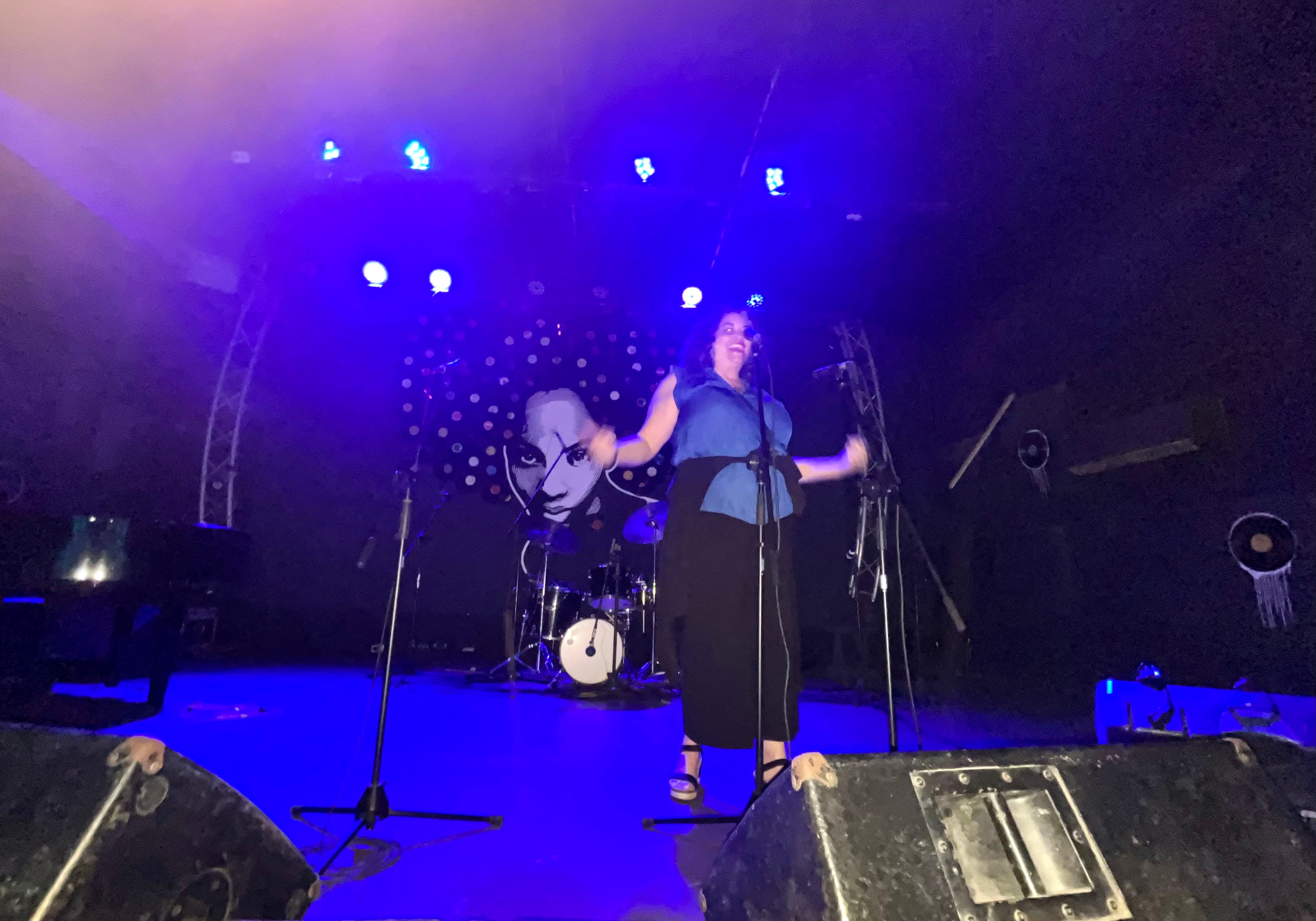
We caught a few raindrops as we worked our way to the 3rd floor. There we found a fancier gallery with a 2-story ceiling, black walls, bar, video projection screen and chairs set up for a fashion show advertised on the screen. We ordered some drinks and took a seat for the show. It started about an hour late, I think. This was the only event that conformed to the Latin American concept of time that I learned in my high school Spanish class (i.e., that everything starts much later than advertised). I was later informed that Cubans are too busy for siestas. They’re probably too busy for that supposedly Latin American concept of time as well.
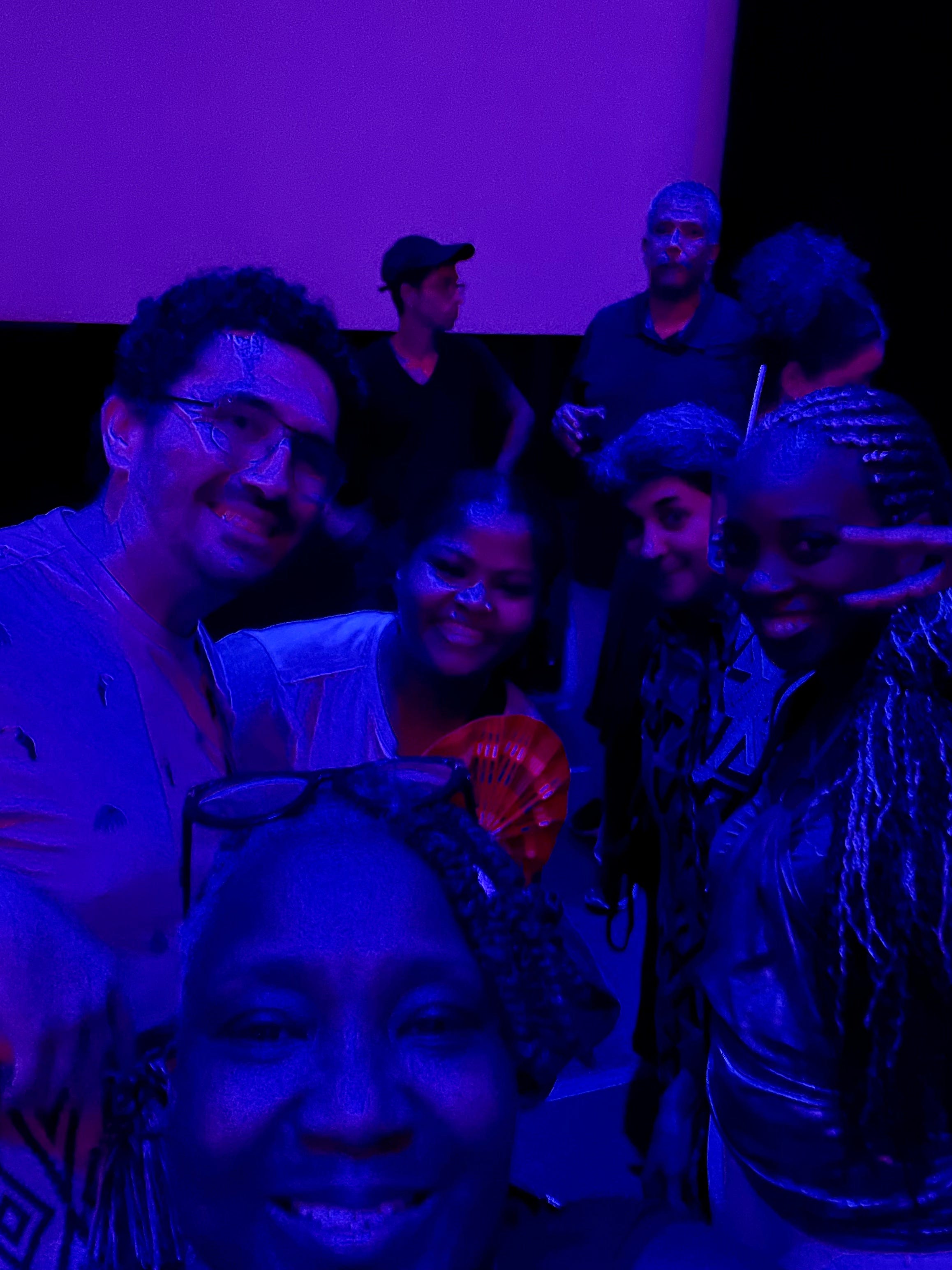
I felt a bit embarrassed wearing a t-shirt and jeans to a fashion show, but there were other attendees in similar attire. I was gob-smacked by the beauty of some of the models. They walked in the typical, stone-faced style of contemporary fashion shows to the beat of techno. (Or is it “EDM,” now? I’m probably showing my age by calling it “techno.”) Some of them were quite tall and slender, just like you’d see on a runway in Milan or New York City.
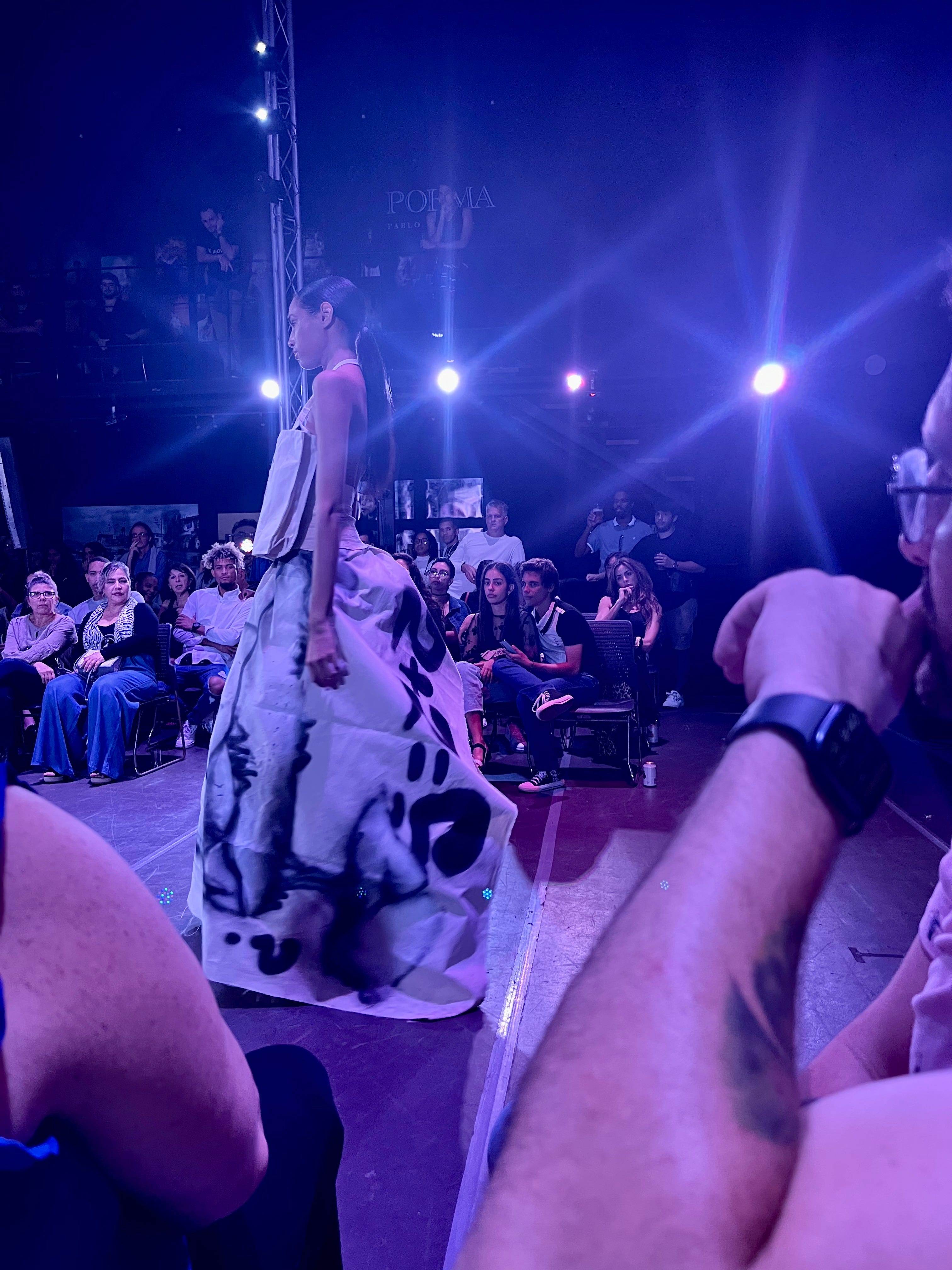
They all carried white canvas bags. That seemed to be the theme of the show. I couldn’t tell if it was a joke or these bags were supposed to be fashionable. All the models looked very serious, so it didn’t seem like a joke, and I didn’t dare laugh or even smile. I was too intimidated for that.
It was about 10pm when we rendezvoused outside the door. There were classic American cars parked on the street and a line of people waiting to get in who were dressed more fashionably than I. The place reminded me of Andy Warhol’s “Factory” (mainly because of the name).
Even though I wasn’t used to being so active, I still needed a shower and meditation in order to relax enough to sleep. Back in 2009, I was informed that I’m actually an extrovert, despite having some social anxiety. I’m sure I was wound up by being around people all day, which is rare for me. Even when I was working for Habitat for Humanity and interacting with volunteers 5 days a week, I was mostly on my own in the evening and on weekends.
The Lexapro (that I wasn’t able to refill before the trip) might’ve helped calm me down, but I didn’t feel that anxious, especially having the room to myself. Having a roommate might’ve even helped, because I felt rather isolated. It was just tough going from being surrounded by people all day to alone. It would’ve been nice to have someone to decompress with. At the same time, I would’ve needed to feel very comfortable with them, a tall order for someone I would’ve just met. In other words, I was stuck with myself.
It took me at least 2 hours each night to shower, meditate and then get to sleep, which is definitely not normal for me. Usually I can fall asleep within a few minutes of turning out the light. Of course, our days started at 8am which I wasn’t used to after 2 years of working from home.